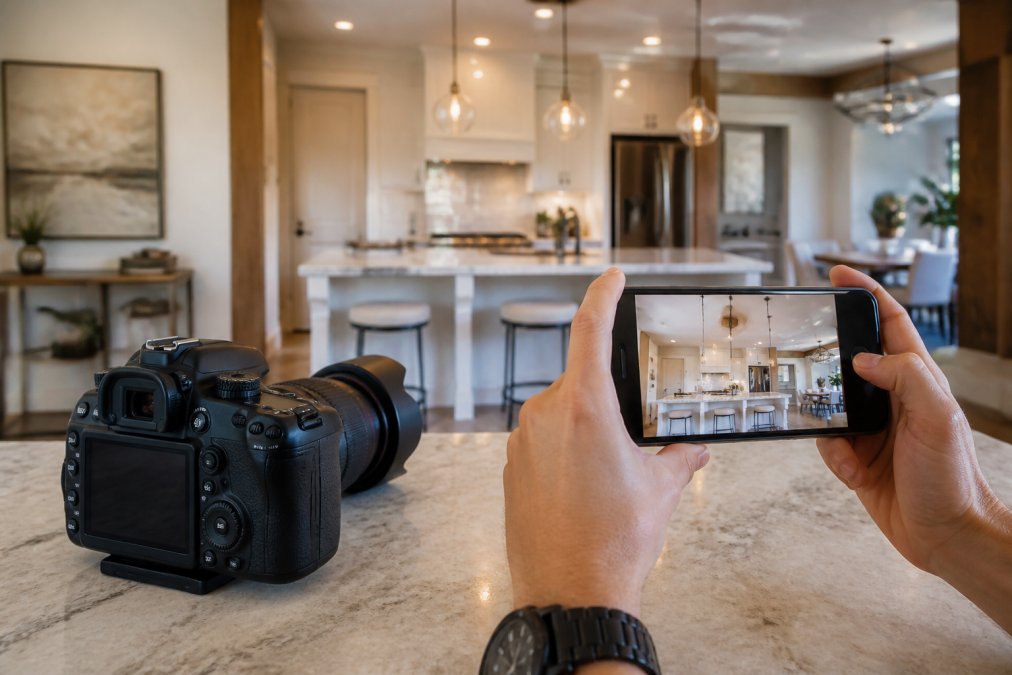
 comparison
Real Estate Photography vs Smartphone Photos for Agents
Table of Contents
- Real Estate Photography vs Smartphone Photos: The Core Differences
- How to Take Professional Real Estate Photos with a Smartphone
- Benefits of Hiring a Professional Real Estate Photographer
- Real Estate Photography ROI Statistics and Impact on Sales
- When to Use Smartphone Photos vs Professional Photography
- Platform-Specific Optimization for Real Estate Listings
- Making the Business Case: Cost-Benefit for Your Agency
- Frequently Asked Questions
Last Updated: September 22, 2026
Real Estate Photography vs Smartphone Photos: The Core Differences
The difference between professional real estate photography and smartphone photos comes down to three core factors: technical capability, consistency, and buyer psychology. Professional cameras capture wider perspectives, control light precisely, and render colors accurately. Smartphones, while increasingly capable, struggle with interior lighting, dynamic range, and the wide-angle composition that makes spaces feel inviting.
For agents deciding between professional real estate photography and smartphone photos, the choice hinges on price range. A $250K suburban home might perform adequately with smartphone images. A $1.2M property in Paradise Valley or Scottsdale will sit longer without professional work.
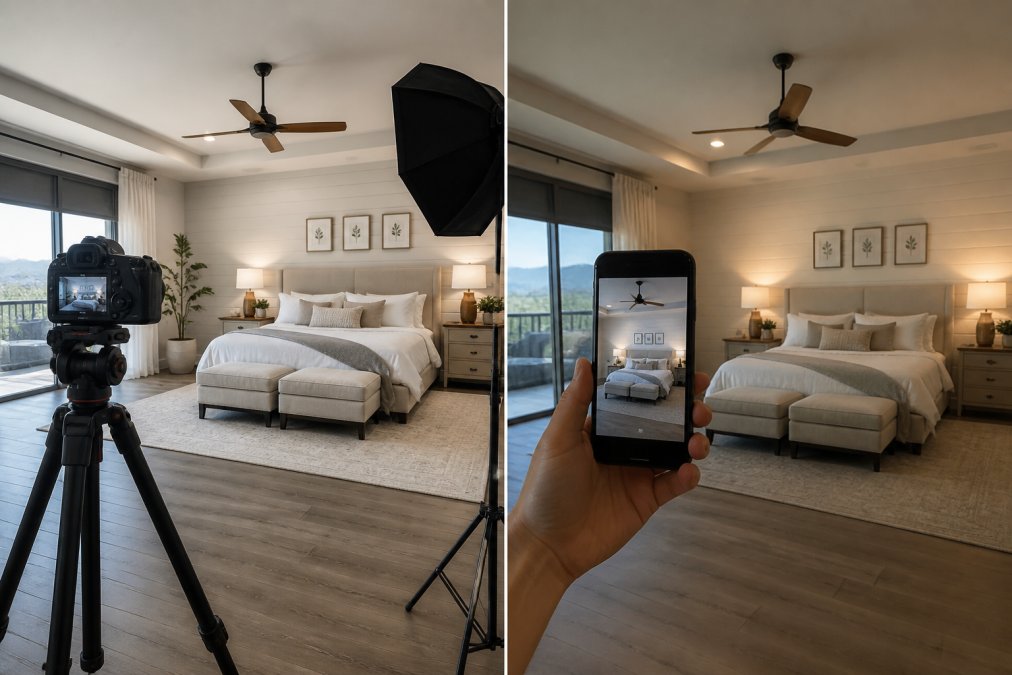
Professional cameras use larger sensors, better lenses, and manual controls that smartphones cannot replicate. A 24mm wide-angle lens captures full room context; most smartphones default to 28mm equivalent, distorting perspective. Professional post-processing, color correction, exposure bracketing, and hand-blended imaging, transforms raw captures into polished visuals buyers expect.
Smartphone photos suffer from lens flare, muddy shadows, and blown-out skies, hardware limitations, not user errors. Professional photographers solve these with equipment designed for real estate work.
How to Take Professional Real Estate Photos with a Smartphone
Use a tripod for stability, shoot during golden hour or overcast conditions, and enable manual controls through a third-party app. Most smartphones now include RAW format capture for post-processing flexibility.
Frame shots to show depth and scale. Include furniture or doorways for spatial reference. Shoot vertically for interiors to capture ceiling height.
Lighting reveals smartphone limitations. A bedroom with one window forces a choice: blow out the window or darken the room. Professional photographers use exposure bracketing and blending; approximating this manually is time-intensive.
Set white balance to tungsten (for warm indoor bulbs) or daylight (for natural light) rather than auto, which produces inconsistent results.
On MLS platforms, aggressive compression exacerbates smartphone photos' weaknesses: color banding, shadow loss, and noise. Professional photos withstand compression better due to superior technical quality.
On Zillow and Realtor.com (where 80%+ of buyers search), mobile-first display crops images. Professional photos maintain spatial context when cropped; smartphone photos often lose scale and clarity.
On social media, professional photos outperform smartphone images due to superior color accuracy and dynamic range.
AI Enhancement and Disclosure Considerations
If you use AI-enhancement tools on smartphone photos, you may have disclosure obligations under NAR Code of Ethics (When Does Enhancing Listing Photos Go Too Far?). The safest approach: document enhancements and disclose if asked. Avoid AI tools that claim to "improve" appearance; stick to exposure correction, white balance, and perspective straightening, defensible techniques that don't cross into misrepresentation.
Smartphone photography documents a property but cannot consistently convert browsers into showings on mobile-first platforms. Even with perfect technique, results underperform professional imagery. The trade-off: save upfront costs but lose 5-15 days on market and miss qualified buyers. For properties under $300K with excellent light, this may be acceptable. For $400K+ or competitive markets, professional photography pays for itself.
Benefits of Hiring a Professional Real Estate Photographer
Professional photographers bring technical expertise, specialized equipment, and consistency. Professional cameras have sensors 10-15 times larger than smartphones, capturing more light and rendering colors accurately. Wide-angle lenses (16-35mm) show full room context. Lighting equipment fills shadows and balances bright windows.
Professional photographers understand real estate composition: spatial flow, foreground depth, and how to photograph challenging spaces. They know which angles highlight features and which expose flaws.
Hand-blended imaging combines multiple exposures to recover shadow and highlight detail. Color correction ensures consistent tones. Perspective correction straightens tilted lines, making rooms look stable rather than distorted.
Consistent aesthetic across all photos builds buyer trust. Professional photographers also offer FAA-licensed drone photography (showing lot size and context) and virtual tours, full storytelling capability that smartphone photography cannot provide.
Real Estate Photography ROI Statistics and Impact on Sales
Properties with professional photography spend less time on market and attract more qualified showings. The ROI question requires specificity: How much faster? For which price ranges?
Professional photography reduces time-on-market by 5-15 days depending on price range. Under $300K: 3-5 days. $500K-$1M: 10-20 days. Luxury ($2M+): 20-30 days faster.
Why does this matter? A property that sells 15 days faster at list price generates more profit than one requiring a $25K price reduction to move. For an agent earning 2.5% commission on a $750K sale, 15 days of faster marketing translates to roughly $4,700 in additional commission, far exceeding the cost of professional photography.
The ROI Calculation Framework
Agents should calculate ROI using this formula:
ROI = (Days Saved × Daily Commission Value) − Photography Cost
Example:
- Property sale price: $600K
- Agent commission: 2.5% = $15,000
- Daily commission value: $15,000 ÷ 90 (average days on market) = $167/day
- Professional photography cost: (refer to Desert Home Photography for current pricing)
- Estimated days saved with professional photos: 8 days
- ROI calculation: (8 × $167) − $500 = $1,336 − $500 = $836 net gain
For agents managing 15-20 listings monthly, even if professional photography saves only 5-7 days per listing on average, the cumulative ROI across a year's pipeline justifies the investment as a standard operational cost.
Buyer Engagement Metrics
Listings with professional photography generate measurably higher engagement. Listings with professional photography generate measurably higher engagement. Properties with professional photos receive more inquiries than listings with smartphone photos. Time-on-page metrics for listings with professional imagery are higher than those with low-quality photos. This engagement translates directly into more showings, which increases the probability of multiple offers and price negotiation leverage.
Smartphone photos often trigger a "quick scroll past" behavior. Buyers form negative first impressions within seconds. Even if you add professional photos later, the listing's initial visibility and click-through rate are already compromised. This is why timing matters: professional photography should happen before listing goes live, not after initial underperformance.
Market Segment Reality
In luxury markets (properties $1.5M+), professional photography is not optional, it's a baseline expectation. Smartphone photos on a luxury listing signal either budget constraints or lack of marketing sophistication. Buyers in that segment expect drone photography, virtual tours, and hand-blended imaging that showcases architectural detail and natural light. The cost of professional photography is negligible compared to the commission at stake.
In mid-market segments ($400K-$800K), professional photography is the competitive differentiator. Properties with professional imagery outsell comparable properties with smartphone photos faster, on average. The cost-benefit analysis is clear: professional photography pays for itself in reduced time-on-market.
In entry-level segments (under $300K), smartphone photography may be adequate for well-maintained properties with strong natural light and minimal staging needs. However, even in this segment, professional photography can justify itself if it reduces time-on-market by 3-5 days on a property with a $200K+ sale price.
The Hidden Cost of Waiting
Agents who delay professional photography to "get the listing live fast" often underestimate the cost of poor first impressions. A listing that sits for 20 days with smartphone photos, then gets professional photos added, has already lost buyer momentum. The listing appears "stale" in buyer feeds. Algorithmic ranking on MLS platforms and portals favors recently updated listings, but the damage from initial poor presentation is difficult to recover.
When to Use Smartphone Photos vs Professional Photography
The decision depends on property tier, market conditions, and your agency's positioning. Use smartphone photos only when you're confident the property's features are strong enough to overcome technical limitations. This typically applies to newer construction, well-maintained properties in lower price ranges, or properties with excellent natural light and minimal staging needs.
Professional real estate photography is essential for:
- Properties above $500K (where buyer expectations are highest)
- Luxury listings in Scottsdale, Paradise Valley, and similar markets
- Properties with challenging lighting (dark interiors, north-facing rooms)
- Listings in competitive markets where visual differentiation matters
- Properties with unique architectural features that deserve professional presentation
- Your flagship listings, the ones that define your brand
Platform-Specific Optimization for Real Estate Listings
Different platforms display images differently. MLS systems compress photos and display them at smaller sizes. Social media platforms crop images and prioritize certain aspect ratios. Websites allow full-resolution viewing. Professional photographers understand these platform requirements and optimize accordingly.
Making the Business Case: Cost-Benefit for Your Agency
The cost question is inevitable: how much is professional real estate photography per listing? Pricing depends on property size, location, complexity, and what additional services you need. Contact Desert Home Photography directly for a quote tailored to your specific needs and volume.
Frequently Asked Questions
Does professional real estate photography actually increase the final sale price of a home?
Professional real estate photography directly impacts buyer behavior and listing performance. Properties with high-quality imagery receive more inquiries, spend less time on market, and attract serious buyers willing to schedule viewings. While photography itself doesn't guarantee a higher sale price, the increased buyer interest and reduced days-on-market translate to better negotiating position for sellers. Agents report that professional photos generate more qualified leads compared to smartphone photos.
What equipment do professional real estate photographers use that smartphones lack?
Professional real estate photography equipment includes wide-angle lenses (typically 14-24mm), tripods for stable composition, external lighting to manage interior shadows, and high-resolution cameras with manual controls for aperture and ISO settings. Professionals also use exposure bracketing to capture high dynamic range images, color correction tools, and post-processing software for hand-blended editing. Smartphones have fixed focal lengths and limited manual control, making it difficult to manage challenging interior lighting and perspective distortion that professionals handle routinely.
What are the most common mistakes agents make with smartphone real estate photos?
Common smartphone mistakes include shooting in auto mode without adjusting white balance, creating lens flare near windows, using digital zoom instead of moving closer, and photographing rooms with uneven lighting that creates dark shadows. Agents often shoot too many angled shots instead of straight-on compositions, include clutter in frames, and fail to use tripods for stable images. Professional photographers avoid these by using manual settings, proper staging, controlled lighting, and composition techniques that showcase properties effectively.
How does high-quality imagery impact a property's time on market?
Properties photographed professionally typically spend less time on market than those with smartphone photos. High-quality images with proper lighting, composition, and color correction attract more buyer inquiries early in the listing period, creating competitive interest and momentum. Professional photography also reduces the number of showings needed because serious buyers are pre-qualified by the listing photos, they've already decided the property meets their needs visually before scheduling a tour.