 ultimate-guide
Architectural Photography for Luxury Real Estate: A 2026 Guide
Table of Contents
- Architecture vs. Real Estate Photography: Key Differences
- Essential Equipment and Lighting Techniques for Luxury Interiors
- Composition and Capturing Architectural Details
- Drone Photography for Luxury Real Estate
- Best Practices for Luxury Real Estate Listing Photos
- Real Estate Photography Pricing and ROI for Luxury Listings
- Client Communication and Legal Considerations
- Conclusion
Last Updated: August 29, 2026
Architecture vs. Real Estate Photography: Key Differences
Architectural photography for luxury real estate differs fundamentally from standard real estate photography in intent, execution, and impact. While real estate photography aims to sell a property quickly by showing its livable features, architectural photography elevates the visual narrative to showcase design excellence, spatial relationships, and the property's unique architectural merit.
Luxury buyers invest in curated design and craftsmanship, not just square footage. Architectural photography tells a story about how spaces function, connect, and inspire, capturing not just furniture and layout, but the interplay of natural light, material textures, proportions, and landscape relationships. This approach requires different equipment, shooting angles, and post-production workflows that prioritize impact over speed.
For luxury properties in competitive markets, this difference translates directly to buyer perception. A home photographed with architectural intention commands attention, attracts serious buyers, and justifies premium pricing. At Desert Home Photography, we approach every luxury listing as an architectural story worth telling.
Essential Equipment and Lighting Techniques for Luxury Interiors
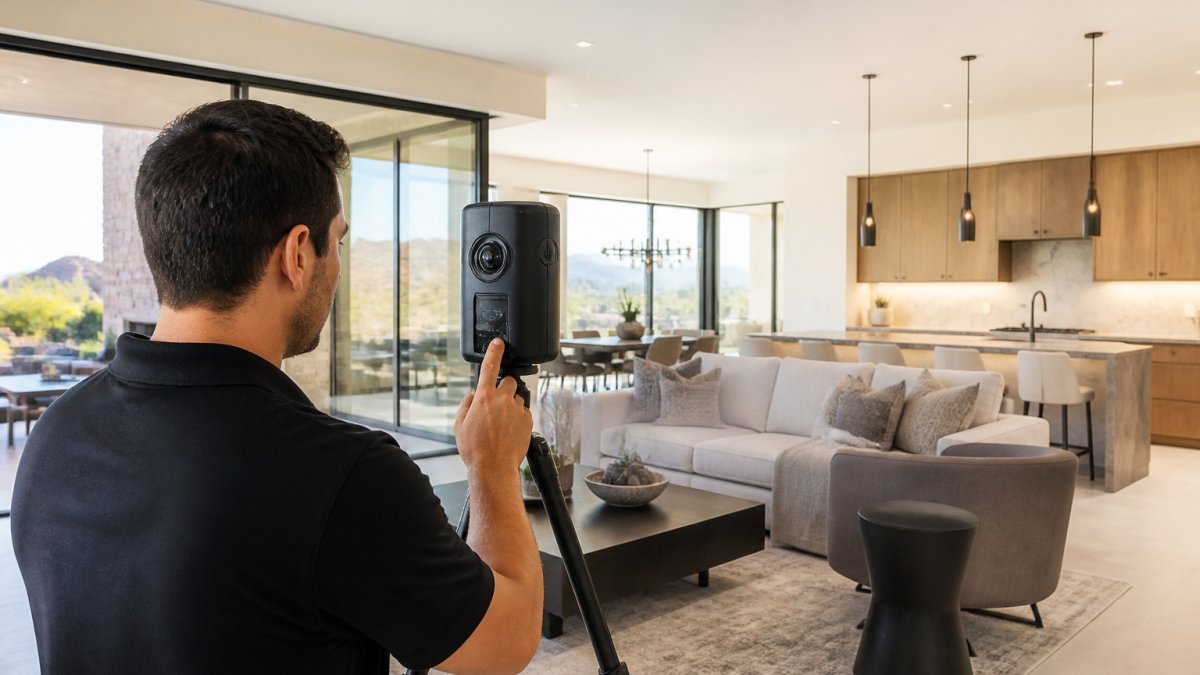
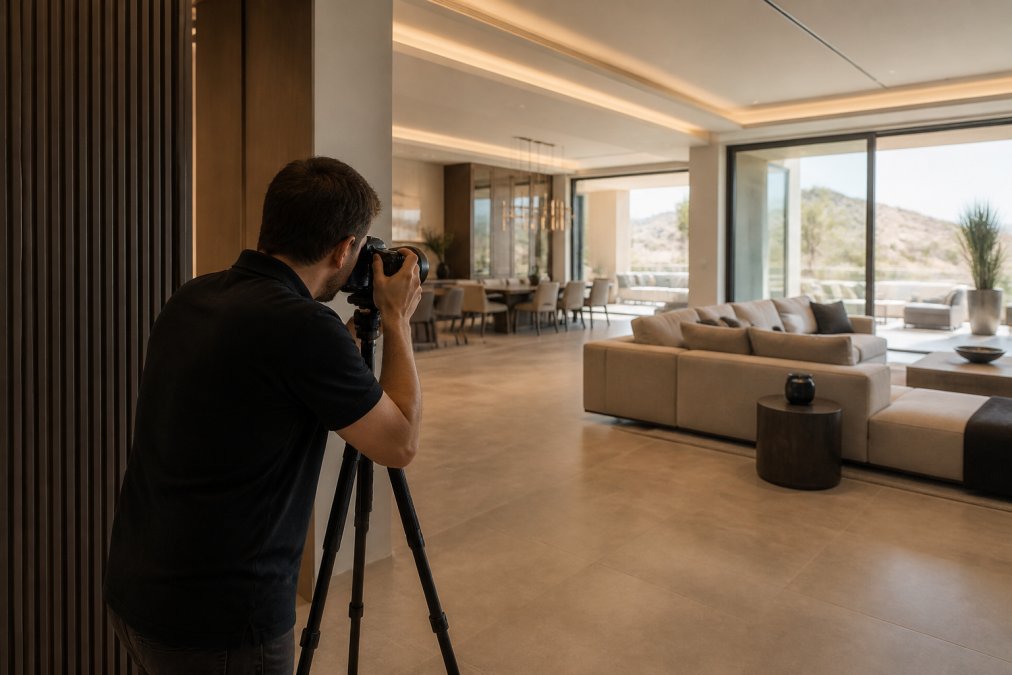
Professional architectural photography requires specialized equipment that enables perspective control, manages complex lighting, and captures spatial flow.
Wide-Angle Lenses and Perspective Control
Wide-angle lenses between 16mm and 35mm (full-frame equivalent) capture entire rooms and show how spaces connect. The critical challenge is distortion: standard wide-angle shots bend vertical lines, making walls appear to lean inward and undermining architectural integrity.
Perspective control lenses (shift lenses) correct this by allowing lens element movement without tilting the camera body, maintaining vertical alignment while preserving the wide view (peer-reviewed research). For luxury interiors, vertical alignment is foundational, converging walls look unstable and cheap, even in architecturally sound spaces. Tilt-shift lenses offer additional creative control, adjusting the plane of focus independently from camera tilt to manage depth of field across foreground to background.
Ambient Light and Strobe Setup
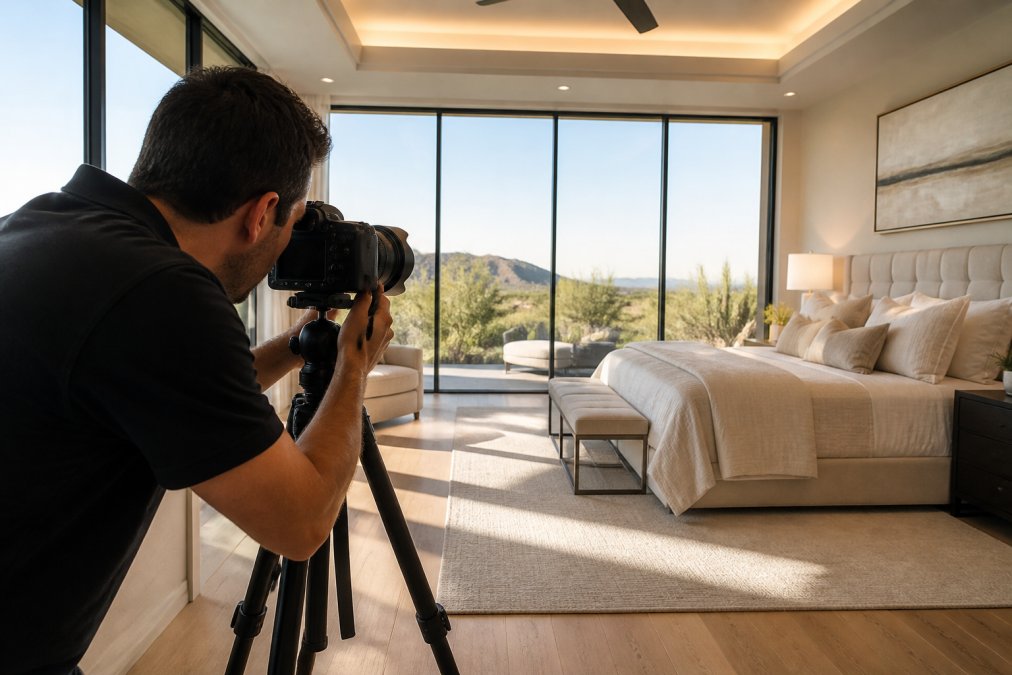
Luxury interiors present a lighting puzzle: windows create harsh shadows, interior ambient light is insufficient or color-cast yellow from tungsten bulbs. Architectural photography requires balancing these sources to create an editorial look that feels both natural and intentional.
Timing directly influences ambient mood. Morning light from the east creates warm, directional shadows. Afternoon light from the west produces stronger shadows. Midday light from the north provides even, cool illumination ideal for detail work.
Strobes fill shadows subtly without dominating natural light. The best setups are invisible, viewers see only natural-looking light that reveals detail. Overpowered strobe lighting flattens rooms and destroys depth. Color temperature consistency matters enormously: strobes (typically 5500K daylight) mixing with tungsten room lights (3200K) creates competing color casts difficult to correct in post-production. Many photographers gel strobes to match ambient tungsten or gel room lights to match daylight.
Composition and Capturing Architectural Details
Composition in architectural photography orchestrates visual hierarchy, guiding viewers through the space's best features.
Leading lines are your primary compositional tool. Countertop edges, cabinet lines, staircase handrails, and hallway walls naturally direct the eye through space. Identifying these lines and positioning your camera to emphasize them creates intentional, composed images.
Layering depth separates architectural photography from flat documentation. Position yourself to include foreground elements (a chair, doorway frame, architectural detail), mid-ground (the main room), and background (windows, views, additional spaces). This creates spatial flow and three-dimensional feel.
Capturing architectural details requires attention to materials and textures that justify luxury pricing. Shoot at angles showing material depth, use raking light emphasizing texture, and compose to isolate details defining the space's quality. A marble fireplace deserves a shot revealing stone veining; custom cabinetry warrants a detail frame showing joinery and hardware. These shots combined with wider room views create comprehensive visual narrative communicating luxury through specificity.
Color harmony influences how viewers perceive space. Neutral-toned luxury interiors benefit from careful attention to how accent colors balance within the frame. Warm tones feel inviting; cool tones feel sophisticated. Your compositional choices enhance or fight against the room's intended mood.
Drone Photography for Luxury Real Estate
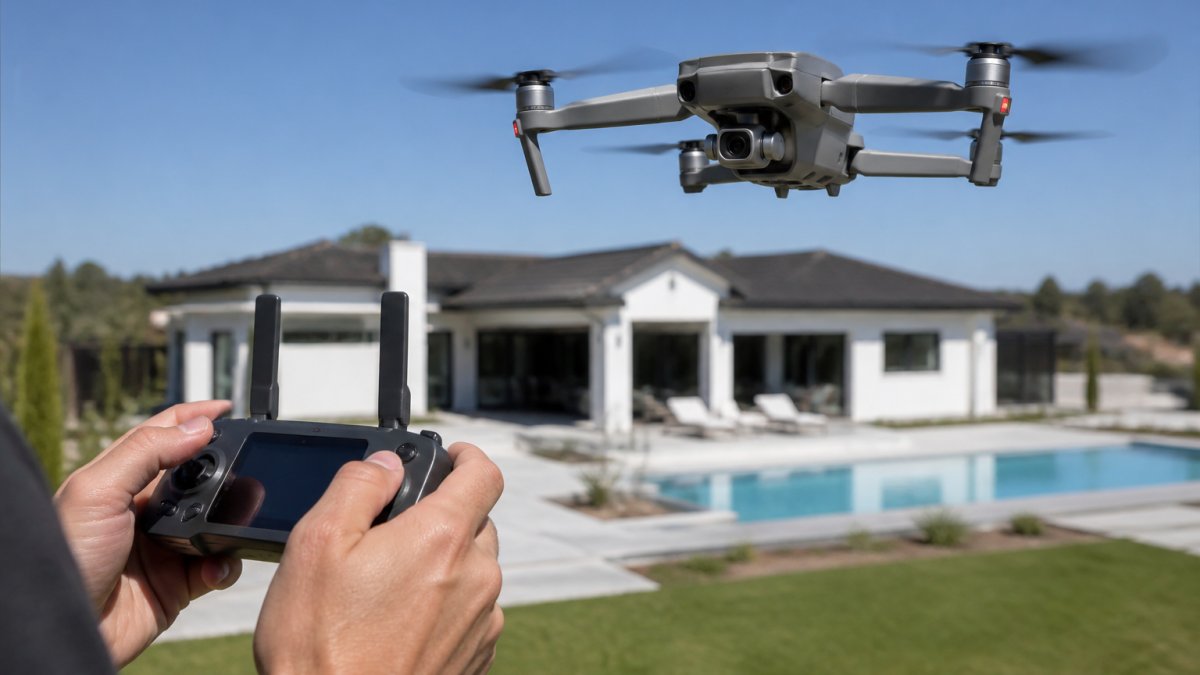
Aerial perspective has become essential for luxury real estate marketing. Drone photography reveals property scale, landscape integration, outdoor living spaces, and architectural rooflines in ways ground-level photography cannot. For estates with significant acreage, pools, gardens, or distinctive rooflines, drone imagery often differentiates a standard listing from a portfolio-quality presentation.
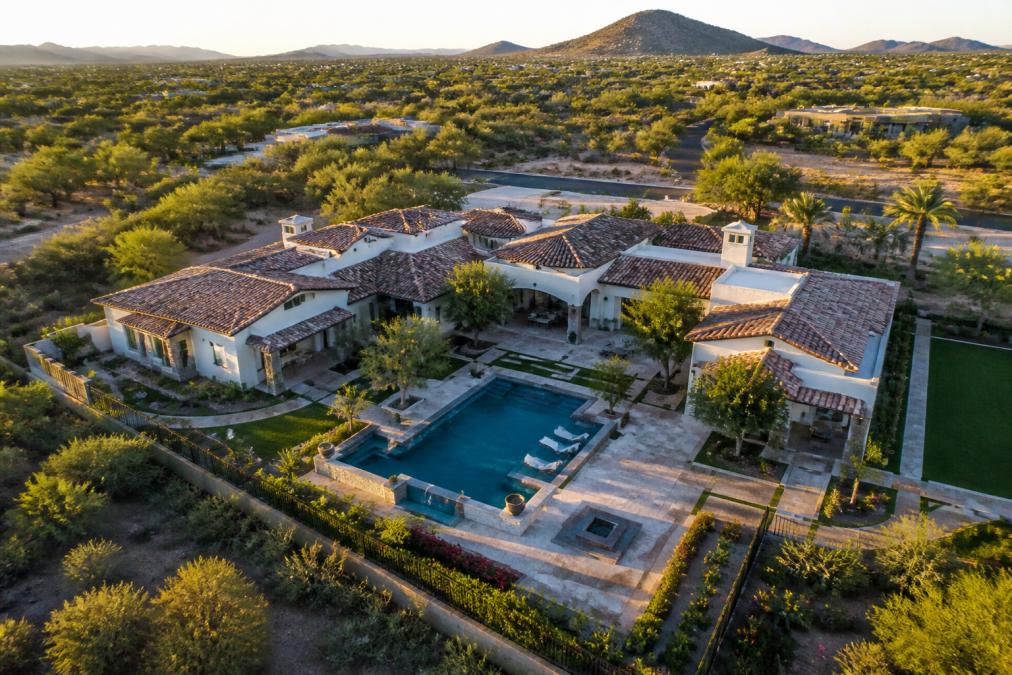
Professional luxury drone work requires FAA Part 107 certification for commercial operations, precision flying, sophisticated camera settings, and post-production workflows matching ground-level architectural imagery quality (faa.gov).
Golden hour (first hour after sunrise, last hour before sunset) creates directional light emphasizing architectural features and landscape texture (usgs.gov). Midday overhead shots show property layout and pool features but lack dimensional quality. Many luxury properties benefit from both overview shots at midday and artistic angle shots during golden hour.
Aerial composition follows similar principles as ground-level work: leading lines, layering, and visual hierarchy. A curved driveway becomes a compositional element; tree-lined edges frame the home; a pool in foreground with home in mid-ground and landscape beyond creates depth. At Desert Home Photography, our FAA-licensed drone operators capture the architectural story from perspectives ground photography cannot achieve.
Best Practices for Luxury Real Estate Listing Photos
Creating listing photos that attract serious buyers requires discipline across property preparation, timing, technical execution, and post-production.
Staging and Property Preparation
Staging transforms a property from "lived-in" to "magazine-ready." For luxury homes, staging highlights architectural merit through restraint. Remove items obscuring detail and competing for attention. If a room's defining feature is a fireplace, clear the mantel to emphasize it. If a kitchen's strength is proportions and natural light, minimize countertop clutter and ensure windows are unobstructed.
Lighting fixtures should be on during photography. Illuminated rooms feel welcoming and showcase the home's lighting design. Fresh flowers in a single statement vase add life without clutter. Plants in key spaces add color and organic texture.
Exterior staging matters equally. Manicured landscaping, clean driveways, and visible architectural features should be the focus. Power-wash exterior surfaces to reveal color and detail. Trim vegetation obscuring windows or architectural elements. For properties with pools, ensure water is crystal clear and surrounding areas immaculate.
Golden Hour and Twilight Shoots
Golden hour produces the most compelling architectural photography for luxury real estate. Low-angle sun creates dimensional light emphasizing texture, revealing material quality, and producing warm luxury-associated tones. For interiors, golden hour light streaming through windows creates natural backlight separating rooms from backgrounds and adding depth.
Twilight shoots (after sunset, before full darkness) capture the home with exterior lighting visible against a deep blue sky, revealing landscape lighting, architectural accent lighting, and nighttime presence. The challenge is timing constraints: you have perhaps 45 minutes of optimal light. Pre-planning, early arrival for scouting, equipment setup before light peaks, and knowing priority shots before the window opens are essential.
Weather adds another variable. Cloud cover diffuses light, eliminating directional quality. Clear days are ideal. Some photographers schedule backup dates ensuring optimal light capture.
Post-Production and Color Grading Workflow
Post-production transforms well-executed photography into editorial-quality imagery. For architectural photography, post-production refines rather than heavily manipulates, enhancing the home's authentic qualities.
RAW files contain significantly more information than JPEGs, allowing shadow detail and highlight nuance recovery. Exposure adjustments ensure bright windows and darker interior spaces retain detail.
Color grading establishes mood. Warm grades (elevated reds and yellows) create inviting, luxurious tones. Cool grades (elevated blues) feel sophisticated and contemporary. The grade should align with design aesthetic. Traditional homes benefit from warm, rich tones; modern minimalist properties suit cooler, cleaner palettes.
Contrast and clarity adjustments define architectural detail. Measured increases make materials pop, stone appears textured, wood grain visible, metal finishes gleam. Excessive clarity produces artificial, over-processed images; restraint produces professional results.
Straightening and perspective correction address geometric distortions. Vertical lines should be truly vertical; horizon lines level. Dust removal, sensor spot cleanup, and minor blemish correction are standard. Many luxury real estate photographers develop consistent color grading presets creating recognizable visual signatures across portfolios.
Real Estate Photography Pricing and ROI for Luxury Listings
Professional architectural photography represents a meaningful investment. Pricing varies based on property size, complexity, location, and deliverables. For current pricing, contact Desert Home Photography for a customized quote.
ROI centers on listing speed and sale price. Homes photographed with professional architectural-quality imagery typically spend less time on market and sell closer to asking price. For luxury properties where asking-to-sale differences represent hundreds of thousands of dollars, professional photography becomes high-ROI investment.
Real estate agents consistently report that professional-quality listing photos generate more qualified inquiries, attract serious buyers, and reduce showing time. Professional photography costs typically represent a small transaction percentage producing measurable returns through faster sales and higher prices.
Client Communication and Legal Considerations
Professional relationships depend on clear communication and documented agreements. Before any shoot, establish expectations around deliverables, timeline, usage rights, and revision processes.
Deliverables should be specified in writing: number of edited images, file formats, resolution, and delivery timeline. Usage rights require clarity: does the client have exclusive rights, or can the photographer use images in portfolios and marketing? Can the real estate agent use images in multiple listings?
Revision processes should have defined limits. FAA regulations govern commercial drone photography, Part 107 certification and compliance with altitude, airspace, and safety protocols are required.
Insurance considerations vary by jurisdiction. Professional liability insurance protects against negligence claims. Property damage insurance covers equipment. Many clients require proof of insurance before engaging services.
Copyright ownership should be explicit. Typically, the photographer retains copyright but grants the client a license for specified purposes. Documentation of property condition before and after staging protects against disputes.
Professional architectural photography for luxury real estate requires technical mastery, compositional sophistication, and understanding how visual storytelling drives buyer decisions. The difference between standard real estate photos and architectural-quality imagery is the difference between a listing that sells and one commanding premium pricing and attracting serious buyers. At Desert Home Photography, we approach every luxury property with editorial rigor and technical precision, transforming homes into portfolio pieces that stand out in competitive markets and communicate true architectural value.
Frequently Asked Questions
What is the difference between architectural photography and real estate photography?
Architectural photography emphasizes design, materials, and structural elements as art, often with editorial-style composition and magazine-quality presentation. Real estate photography prioritizes showing the entire property and lifestyle appeal to attract buyers. Architectural photography focuses on details and visual storytelling; real estate photography shows spatial flow and livability. Both approaches can complement luxury listings, but architectural photography elevates the visual impact and appeals to buyers seeking design-forward homes.
What should be included in a luxury real estate photography package?
A comprehensive luxury real estate package includes interior and exterior photography with professional lighting, drone aerial imagery, twilight or golden hour shots, high-resolution color-graded images, and post-production editing. Many packages also offer virtual walk-through tours and lifestyle photography showing spatial relationships. Best practices require multiple angles of key rooms, architectural details, and materials. Ask your photographer if they provide image resolution suitable for large-format marketing, shadow management in interiors, and highlight recovery for exterior shots, these are hallmarks of professional luxury listing photos.
How does professional architectural photography impact luxury property sales?
Professional architectural photography significantly increases buyer engagement and perceived property value. Magazine-quality imagery attracts more qualified leads, reduces time on market, and justifies higher asking prices. Buyers viewing luxury properties expect curated imagery that showcases materials, textures, and spatial flow. High-dynamic-range processing and proper color accuracy make interiors appear more inviting and spacious. Properties with professional architectural photography receive more inquiries and showings than those with standard photos, directly influencing sales velocity and final sale price.
What techniques do professional photographers use for high-end luxury homes?
Professional photographers use wide-angle lenses with perspective control to show spatial relationships without distortion, strobe lighting combined with ambient light to manage shadows in interiors, and high-dynamic-range processing to capture detail in both highlights and shadows. Composition techniques emphasize vertical alignment and leading lines to draw viewers through the space. Twilight shoots capture exterior architecture with balanced ambient and artificial lighting. Post-production includes selective color grading, shadow management, and highlight recovery. Drone cinematography adds aerial perspective, while lifestyle photography shows how spaces function, creating visual storytelling that appeals to luxury buyers.
Should I hire an architectural photographer for my luxury listing?
Yes, if your property is high-end and marketed to discerning buyers. Architectural photographers specialize in capturing materials, textures, and design details that justify premium pricing. They understand how to light luxury interiors, manage challenging natural light conditions, and create magazine-quality imagery that stands out in competitive markets. For properties in the luxury segment, professional architectural photography typically generates stronger buyer response and faster sales than standard real estate photography. The investment in specialized expertise pays dividends through increased showings and higher perceived value.
How much does professional architectural photography cost for luxury listings?
Pricing depends on property size, location, complexity of interiors, number of images needed, and whether additional services like drone photography or virtual tours are included. Luxury real estate photography pricing varies based on quantity of properties, turnaround time, and editing intensity. Contact Desert Home Photography for a customized quote based on your specific needs and property type. Many agents find that the investment in professional architectural photography returns value through faster sales and higher final prices, making it cost-effective for luxury listings.
How long does it take to receive edited photos after a luxury property shoot?
Turnaround time typically ranges from 3-7 business days depending on the volume of images, complexity of post-production editing, and the photographer's schedule. Rush delivery is often available for an additional fee if you need photos quickly for immediate listing. Professional architectural photography requires careful color grading, shadow management, and highlight recovery, which takes time to execute properly. Discuss timeline expectations with your photographer upfront, especially if you have multiple properties or tight listing deadlines. Fast turnaround combined with quality editing ensures your luxury listings go live without delay.
This article was written using GrandRanker