 ultimate-guide
Hire a Real Estate Photographer in Scottsdale
Table of Contents
- What a Scottsdale Real Estate Photographer Actually Delivers
- Real Estate Photography Pricing: What Drives the Cost Per Listing
- How to Prepare a Home for a Photo Shoot: A Room-by-Room Checklist
- Real Estate Drone Photography Requirements and FAA Rules
- ROI: Do Professional Photos Help Homes Sell Faster?
- Licensing, Copyright, and Who Owns the Photos
- Seasonal Lighting in Arizona: When to Schedule Your Shoot
- Conclusion
- Frequently Asked Questions
Last Updated: September 14, 2026
What a Scottsdale Real Estate Photographer Actually Delivers
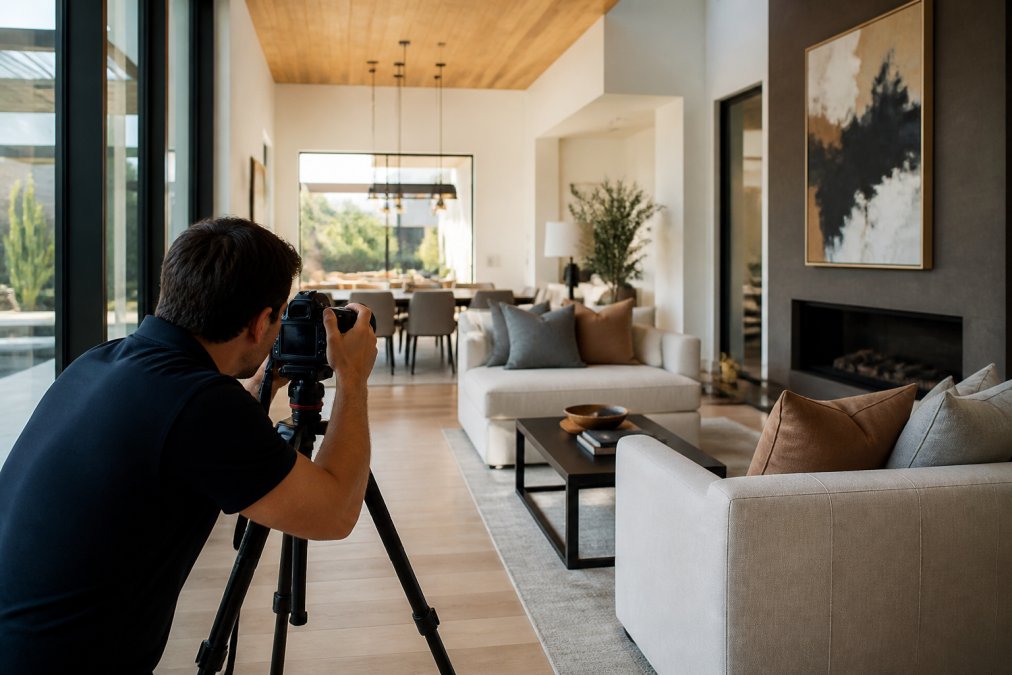
Hiring a real estate photographer in Scottsdale means paying for more than someone with a camera: a trained eye for interior lighting, a wide-angle lens that flatters a room, and post-processing that makes listing photos look the way a home actually feels. At Desert Home Photography, every shoot has one goal: images that stop a buyer mid-scroll and get them into the property.
A real estate photographer captures a property's interior and exterior spaces for marketing, using professional lighting, composition, and editing to present a home at its best.
The difference between a phone snapshot and professional work shows up in three places:
- Dynamic range. Bright windows and dim corners rarely cooperate. A skilled photographer balances both so the view outside stays visible without turning the room into a cave.
- Geometry. Vertical lines should stay vertical. Wide-angle lenses bend walls and ceilings if nobody corrects for it, and buyers notice.
- Consistency. Every room in the gallery should feel like it belongs to the same home, shot the same day, in the same light.
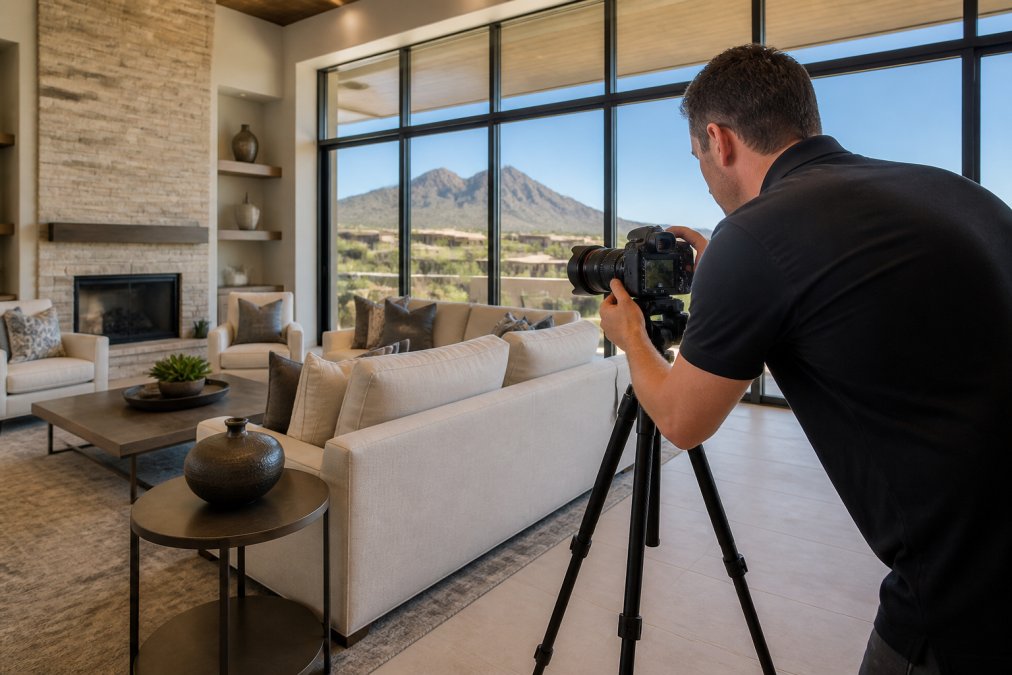
HDR vs. Hand-Blended Editing
HDR photography combines multiple exposures of the same scene so shadows and highlights stay visible. Hand-blended editing goes further: a person manually layers those exposures, painting in the best version of each area rather than letting software decide.
Hand blending keeps the warmth of natural light while pulling detail out of dark corners.
Real Estate Photography Pricing: What Drives the Cost Per Listing
Real estate photography pricing depends on square footage, deliverable image count, travel distance, and add-on services. A standard residential shoot costs less than a luxury property requiring drone coverage, twilight shots, and a 3D tour. Desert Home Photography quotes each listing individually, so call or text with your property details for current pricing.
The Four Numbers That Set Every Quote
Every quote is a stack of four decisions:
- Image count. A condo under 1,500 square feet might need 15 to 20 final images; a 4,000-square-foot home with a casita, pool, and desert landscaping can run 40 to 50. Most photographers price in tiers rather than per image, because editing time scales with the count.
- Property type and condition. Vacant and staged homes shoot faster and need fewer corrective edits. Homes needing heavy decluttering, dark rooms, or mixed lighting take longer in post and are quoted higher.
- Add-ons. Drone, twilight, floor plans, and virtual tours are almost always separate line items on top of the base shoot. Bundling them into one appointment is cheaper because the photographer is already on site.
- Turnaround. Standard delivery is typically 24 to 48 hours. Rush delivery carries a surcharge because it compresses the editing window and pushes other clients back.
Typical Package Structure
Most photographers build their menu around tiers. Exact prices vary, so treat these as structural descriptions:
| Tier | What It Usually Includes | Best For |
|---|---|---|
| Base / Essential | 20-25 edited images, main living areas, kitchen, primary suite, front exterior | Condos, townhomes, smaller resale listings |
| Standard / Full | 30-40 edited images, all bedrooms and bathrooms, exterior front and back, basic floor plan | Most single-family resale listings |
| Premium / Luxury | 40-60+ edited images, drone aerials, twilight exteriors, 3D tour, detailed floor plan | Luxury, view properties, new construction, acreage |
Add-ons are quoted per service: drone aerials, twilight sessions, 2D floor plans, 3D walk-through tours, and cinematic video tours each carry their own line item. On a premium listing, add-ons can approach or exceed the base shoot, which is why bundling matters.
What Actually Moves the Price Up or Down
| Cost Driver | What It Means | Typical Impact |
|---|---|---|
| Square footage | More rooms, more images, more editing time | Moderate increase, often tier-based |
| Add-on services | Drone, twilight, floor plans, virtual tours | Per-service increase |
| Turnaround speed | Rush delivery compresses the editing window | Surcharge |
| Travel distance | Outlying areas add drive time | Mileage-based |
| Volume commitment | Agents booking regularly get better rates | Discount |
| Property condition | Clutter, mixed lighting, or heavy edits | Higher tier or hourly add-on |
Packages, Add-Ons, and Volume Discounts for Agents
Most photographers bundle a base package covering the main living areas, kitchen, primary suite, and exterior, then let you add drone services, floor plans, walk-through tours, and twilight photography.
If you're listing 15 to 20 properties a month, ask about volume pricing before you book a single shoot. A monthly schedule earns a better per-listing rate, locks in your preferred time slots, and gets better results as the photographer learns how you like your galleries presented.
Questions to Ask Before You Sign a Quote
- Is the quoted image count the number of delivered edited images, or the number of frames shot?
- Is drone included, or is it a separate line item with its own weather and airspace contingencies?
- What is the standard turnaround, and what does rush delivery cost?
- Is there a re-shoot policy if the home is not photo-ready when the photographer arrives?
- Does the quote include a license for MLS, web, and social use, or is that billed separately?
How to Prepare a Home for a Photo Shoot: A Room-by-Room Checklist
Preparing a home for a photo shoot is the single highest-return task a seller can do before the camera arrives. A clean, decluttered home photographs larger, brighter, and more expensive. Most of the work takes a few hours the day before.
Use this checklist:
- Kitchen: Clear all counters except one styled item. Remove magnets, notes, and dish towels. Empty the sink.
- Living room: Straighten cushions, hide cords and remotes, remove personal photos.
- Bedrooms: Make beds with clean linens, clear nightstands, tuck away phone chargers.
- Bathrooms: Close toilet lids, remove personal products, hang fresh white towels.
- Exterior: Move trash bins and hoses out of frame, park cars down the street, sweep the driveway.
- Every room: Turn on all lights, open blinds, replace burned-out bulbs, and set ceiling fans to a consistent position.
What most guides miss is the light bulbs. A single warm bulb in a room of cool white ones throws off the entire color balance, and no amount of post-processing fully fixes it. Match your bulbs before the shoot.
Real Estate Drone Photography Requirements and FAA Rules
Real estate drone photography in the United States requires a remote pilot certificate and compliance with Federal Aviation Administration rules (faa.gov). Commercial drone work is not the same as flying a toy in your backyard, the FAA governs who can fly for hire, where, and under what conditions.
Key requirements for commercial drone photography:
- The pilot must hold a current Remote Pilot Certificate under Part 107 (faa.gov).
- The drone must be registered with the FAA.
- Flights must stay within visual line of sight and below the applicable altitude ceiling.
- Certain airspace near airports requires prior authorization.
- Operations over people and moving vehicles carry additional restrictions.
Rules and airspace designations change, so verify current requirements directly with the FAA's official drone guidance before any commercial flight.
Why Licensed Drone Operators Matter for Your Liability
Hiring an unlicensed drone operator puts the liability on you. If an uninsured, uncertified pilot has an incident over a listed property, the agent or homeowner ends up answering questions they never wanted to answer. Desert Home Photography operates with FAA-licensed photographers, keeping that exposure off your side of the table. Before booking any aerial work, ask for the certificate and proof of insurance.
ROI: Do Professional Photos Help Homes Sell Faster?
Professional listing photos consistently outperform amateur images on the metrics sellers care about most: clicks, showings, and days on market. Buyers decide whether to click based on the thumbnail and whether to tour based on the gallery, better images win both decisions.
But "better photos help" is not an ROI argument. To evaluate the investment, you need to know which numbers move, how fast, and what to compare against.
The Four Metrics That Actually Move
When a listing switches from amateur photos to professional ones, the change shows up in four places you can track in your MLS and showing software:
- Click-through rate on the listing thumbnail. On syndicated platforms, the thumbnail is the only thing a buyer sees before deciding to open the listing. A sharper, brighter, correctly composed hero image almost always lifts click-through versus a phone snapshot.
- Saved-to-shown ratio. Buyers save listings they intend to see. Saves with few showings mean the photos are overselling; clicks with few saves mean they're underselling. Professional photography tightens the gap.
- Days on market. This is the metric sellers feel most. Homes that generate strong early traffic tend to go under contract faster, reducing carrying costs, staging costs, and the risk of a price reduction.
- Showing-to-offer conversion. When photos match reality, buyers arrive already interested instead of skeptical. Fewer wasted showings, more serious offers.
The Mechanism: Why the First 7-10 Days Decide the Listing
Most listing traffic is front-loaded. The first week to ten days after a property hits the MLS is when it appears in saved-search alerts, email blasts, and social feeds. After that, it drops out of "new" filters and traffic falls off sharply.
That window is why photography timing matters. A weak initial gallery burns the listing's best traffic window on low click-through, and algorithm-driven platforms respond by showing it to fewer buyers. A strong gallery captures the window and the momentum compounds.
This is also why re-shooting later rarely recovers the same result: the listing is no longer new, and the audience that scrolled past it is unlikely to come back.
How to Measure ROI on Your Own Listings
You do not need a formal study to evaluate this. Track it yourself across your next five to ten listings:
- Record days on market, number of showings in the first 7 days, and final sale price versus list price for each listing.
- Note whether the listing used base package photography or a premium package with drone, twilight, and a 3D tour.
- Compare the two groups after the listings close.
Most agents who run this exercise find premium-photography listings show stronger early showing volume and fewer price reductions, even controlling for price point and neighborhood. Numbers vary by market and season, but the pattern is consistent enough that many brokerages now treat professional photography as a standard listing expense rather than an optional upgrade.
The Cost Framing That Actually Matters
A photography package is a one-time cost that works for the entire listing period, MLS, syndication, social, email, print, and any re-marketing after a price adjustment. Compare that to the recurring costs of a listing that sits: staging months, carrying costs, and the price reduction itself.
A common pattern is that a single avoided price reduction is worth many times the cost of a premium photography package. That is the real ROI calculation.
Licensing, Copyright, and Who Owns the Photos
Copyright for real estate photos belongs to the photographer unless a written agreement transfers it. Paying for a shoot buys you a license to use the images, not ownership of them. This distinction matters more than most agents realize.
Standard licensing typically covers:
- MLS and syndicated listing platforms
- Your own website and social media
- Print materials tied to that specific listing
What it usually does not cover: reselling the images, handing them to a builder or stager for their own marketing, or using them to promote a different property. If you need broader rights, negotiate them in writing before the shoot, a clear license protects both sides.
Seasonal Lighting in Arizona: When to Schedule Your Shoot
The best time to schedule a photo shoot in the Valley depends on the season and how the home faces. Arizona light is intense and changes fast, and the difference between a good gallery and a great one often comes down to timing.
- Winter: Milder sun, longer shadows, and comfortable outdoor shooting. Mid-morning and late afternoon both work well.
- Spring: Bright, clean light. Watch for wind, which complicates drone work and exterior staging.
- Summer: Harsh midday sun washes out exteriors. Early morning shoots avoid the worst of it.
- Monsoon season: Afternoon storms roll in fast. Morning shoots are safer, and flexible scheduling matters.
- Fall: Some of the most balanced light of the year, especially for twilight photography.
Twilight photography deserves its own slot. Shooting just after sunset, when interior lights glow against a deep blue sky, produces the most dramatic exterior images of the year, it works on any home, but transforms a luxury listing in Scottsdale or Paradise Valley.
Conclusion
Getting a listing to market fast, with images that actually sell the property, is the hard part of every agent's week. Desert Home Photography handles that for the Phoenix Valley with hand-blended imaging, FAA-licensed drone photography, and immersive virtual walk-through tours built for real estate. Call or text Desert Home Photography to book your next listing and put your properties in front of buyers the right way.
Frequently Asked Questions
How much does it cost to hire a real estate photographer in Scottsdale?
Real estate photography pricing depends on the size of the property, the number of finished images, and which add-ons you choose, such as drone coverage, virtual tours, or twilight shots. Most photographers price per listing rather than per hour, and agents shooting 15 to 20 properties a month often qualify for volume rates. Ask for a full package breakdown before you book so there are no surprise fees on delivery day.
What should I look for in a real estate photographer's portfolio?
Look for straight vertical lines, balanced interior lighting, and windows that show a view instead of a blown-out white rectangle. Check whether the photographer shoots a mix of price points similar to your listings, from entry-level homes to luxury properties. A portfolio with consistent color and composition across every shot tells you the editing is done in-house rather than outsourced.
Do I need to hire a photographer who is FAA-licensed for drone work?
Yes. Commercial drone photography in the United States requires a remote pilot certificate under FAA Part 107, and the operator must follow airspace rules that affect many areas around Scottsdale and the Phoenix Valley. Hiring an unlicensed operator puts the liability on you if something goes wrong during the flight. Ask to see the certificate and confirm the photographer carries insurance before any aerial shoot.
How long does it take from the photo shoot to delivery?
Turnaround time varies by provider and package, so confirm it before booking. Many professional real estate photographers deliver edited, MLS-ready images within one to two business days, with drone and virtual tour files following shortly after. If you need to list fast, ask whether rush delivery is available and what it costs. Getting the timeline in writing prevents delays on your listing date.