 how-to
How to Calculate ROI for Drone Photography
Last Updated: October 29, 2026
Quick Summary
Drone photography ROI is the percentage return on your total investment, calculated as net profit divided by total cost, expressed as a percentage. Net profit means revenue minus every operating expense, including your own labor, so you compare total net profit against everything you spent to earn it.
- Total investment combines startup costs with recurring costs like insurance, software, and battery replacement.
- Break-even point equals total startup costs divided by profit per job.
- With $4,000 in startup costs and $150 net per job, you need roughly 27 jobs to break even.
- Run conservative, expected, and optimistic scenarios to see your real planning range.
- Track cash available separately from accounting profit so loan payments and taxes don't mislead you.
Table of Contents
- Why Drone Photography ROI Starts With the Right Formula
- Drone Photography Business Startup Costs: What You Pay Before the First Flight
- Drone Photography Pricing: Setting Rates That Cover Your Real Costs
- Drone Photography Break-Even Analysis: Jobs Needed to Recover Your Investment
- Using a Drone Pricing Calculator to Model Different Booking Scenarios
- A Worked ROI Example: From First Invoice to Net Profit
- Book Your First FAA-Licensed Drone Shoot With Desert Home Photography
- Frequently Asked Questions
Why Drone Photography ROI Starts With the Right Formula
Most pilots count revenue and call it profit. That's the mistake that sinks a drone photography business in year one. Calculating return on investment for drone photography means comparing total net profit against everything you spent to earn it, not just the money that landed in your account.
Drone photography ROI is the percentage return on your total investment, calculated as net profit divided by total cost, expressed as a percentage. Net profit means revenue minus every operating expense, including your own labor.
Aerial work has become a standard part of many real estate listings across the Phoenix Valley. The Grand View Research commercial drone market forecast puts the broader drone market at $83.8 billion in 2025, climbing to a projected $96.4 billion in 2026. That growth means more pilots entering the field, which makes disciplined math your real edge.
Here's a common formula for drone photography ROI:
- ROI = (Net Profit ÷ Total Investment) × 100
- Net Profit = Revenue − Operating Expenses − Owner Labor
- Total Investment = Startup Costs + Recurring Costs
Below, we'll show you exactly how to run those numbers step by step, with a worked example you can copy.
Drone Photography Business Startup Costs: What You Pay Before the First Flight
Drone photography business startup costs fall into two buckets: one-time equipment and licensing, and recurring costs that keep you flying. Most new pilots underestimate the second bucket, and that is where ROI quietly erodes.
Startup costs vary widely with equipment choice, coverage, and software. For current pricing on the drone photography services Desert Home Photography offers, visit our website or request a quote.
Recurring costs to model from day one:
- Battery replacement (lithium packs degrade and eventually swell)
- Repairs and propeller replacements after minor crashes
- Insurance renewals
- Software subscriptions
- Travel and mileage to shoots
- Storage for raw footage and edited deliverables
- Equipment replacement reserve (set aside a percentage of revenue each month)
- Self-employment taxes and quarterly estimated payments
Financing changes the math. If you put the equipment on a business credit card or a small equipment loan, your monthly payment is a cash outflow even in months with no bookings. That does not change total ROI, but it changes your break-even timeline and cash flow. Track the loan payment separately from operating expenses so you can see true cash available.
If you are benchmarking what professional photography services charge so you can price your own work, our residential architectural photography pricing guide breaks down the categories.
Drone Photography Pricing: Setting Rates That Cover Your Real Costs
Drone photography pricing should start from your costs rather than from what other providers charge. Work backward: figure out your cost per shoot, add your target margin, then set the rate.
Three pricing models dominate:
- Project rate: A flat fee per property, easiest for agents to budget
- Hourly rate: Billed by time on site plus editing hours
- Service package: Aerial stills, video footage, and edited deliverables bundled together
Many real estate clients prefer a package with a predictable price per listing.
A common mistake is pricing only the flight time. Editing often takes as long as the shoot itself, so build billable hours for post-production into every quote.
For a sense of how professional packages are structured, our affordable real estate photography pricing plans in Phoenix show how service tiers are built.
Drone Photography Break-Even Analysis: Jobs Needed to Recover Your Investment
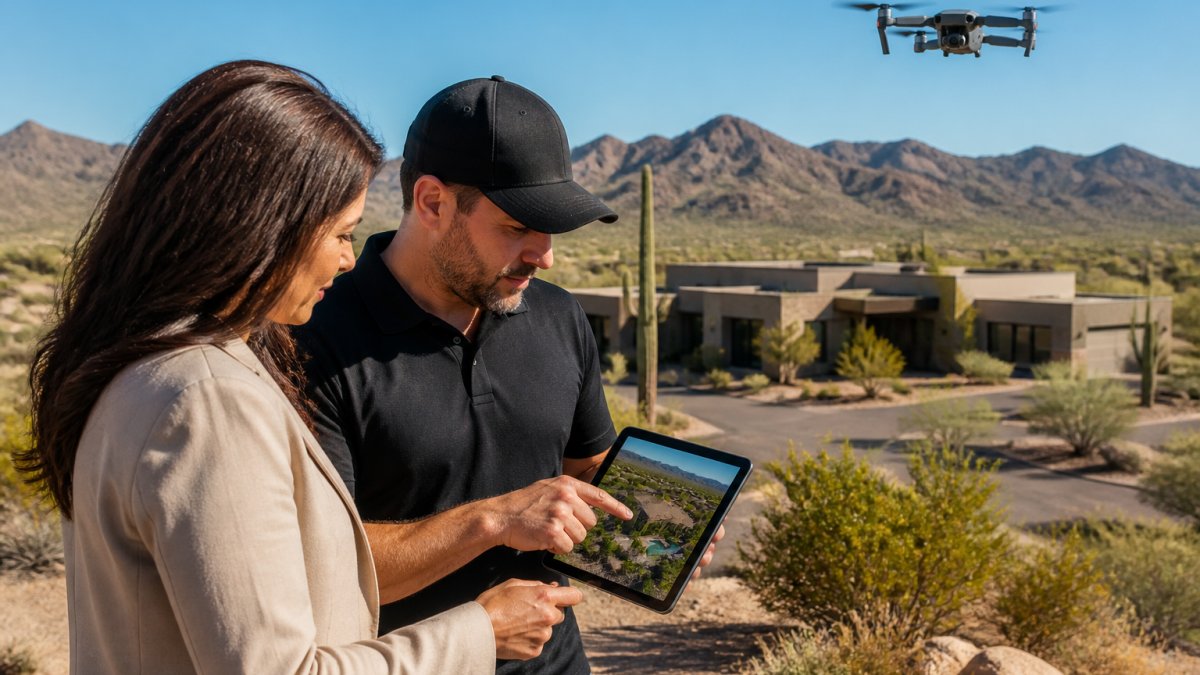
Drone photography break-even analysis answers one question: how many jobs until you have recovered your startup costs?
Break-even point = Total Startup Costs ÷ Profit Per Job.
Here is how it works in practice. Say your startup costs total $4,000 and each job nets $150 after expenses and labor. Divide 4,000 by 150 and you get roughly 27 jobs to break even. At four shoots a week, that is about seven weeks.
The payback period is that same math expressed in time. Track it monthly so you know whether you are ahead of schedule or behind.
But a single break-even number hides the risk. Run a sensitivity analysis by changing one input at a time:
- Conservative case: 6 jobs per month at $175, with higher travel and editing time. Break-even stretches well past a year.
- Expected case: 10 jobs per month at $200. Break-even in roughly five to six months.
- Optimistic case: 15 jobs per month at $225 with a recurring commercial client. Break-even in under three months.
The spread between conservative and optimistic is your real planning range. Most solo pilots find the conservative case is closer to reality in the first six months while they build a client base.
Segment mix changes break-even too. Real estate listing shoots are high-volume but price-sensitive. Construction progress documentation and inspection work are lower-volume but often recurring and higher-margin. A mix of both smooths cash flow and shortens the effective payback period because recurring contracts reduce the unpaid sales work that eats into billable hours.
Accounting profit is not cash. If you financed equipment, your loan payment is a cash outflow that does not appear in a simple profit calculation. Taxes are another cash outflow. A job that nets $150 on paper may leave less available to reinvest once you set aside quarterly estimated taxes and a repair reserve. Track cash available separately from accounting profit so you do not mistake a healthy ROI percentage for money in the bank.
A utility-inspection resource from Innovate Energy Now on drone program value argues that ROI should weigh safety and quality alongside dollars. Fair point. But for a solo photography business, cash recovery comes first.
The article runs three booking scenarios to show how wide the break-even range can be.
| Scenario | Jobs per month | Price per job | Break-even |
|---|---|---|---|
| Conservative case | 6 | $175 | Well past a year |
| Expected case | 10 | $200 | Roughly five to six months |
| Optimistic case | 15 | $225 | Under three months |
Using a Drone Pricing Calculator to Model Different Booking Scenarios
A drone pricing calculator lets you test assumptions before you commit. Build a simple spreadsheet with these inputs:
- Jobs booked per month
- Average price per job
- Variable cost per job (travel, editing time, battery wear)
- Fixed monthly costs (insurance, software, marketing)
- Owner labor hours per job
Then run scenario and sensitivity analysis. Change one input at a time.
- What if bookings drop 30% in summer?
- What if you raise prices 15% and lose 10% of clients?
- What if editing time doubles on luxury properties?
This is where most guides stop short. They give you one tidy number and move on. Real businesses live in the spread between best case and worst case, so model both.
Track customer demand by segment too. Agents handling 15-20 listings a month buy differently than a homeowner selling once. A mixed service package spread across both segments smooths your cash flow.
A Worked ROI Example: From First Invoice to Net Profit
Let's run the full calculation. Assume a pilot invests $5,000 in equipment, licensing, and insurance, then books 10 jobs a month at $200 each.
The formula works the same at any booking volume: enter your own revenue, expenses, and labor to see your projected return.
Same pilot, same gear, wildly different outcome. Booking volume is the lever that matters most.
A construction example from Propeller Aero's drone ROI case study reports $1.7 million in savings from a drone program. That's a different scale, but the lesson holds: measure outcomes, not activity.
Book Your First FAA-Licensed Drone Shoot With Desert Home Photography
The math only works if the work is legal and insured. Flying commercially without a remote pilot certificate under Part 107 puts your entire business at risk.
Desert Home Photography works with FAA-licensed drone operators. Our team offers immersive virtual walk-through tours and drone photography, using hand-blended imaging.
Before you hire any pilot, run through our guide to choosing a licensed drone pilot to verify credentials. Then review our full real estate and architectural photography services to see what a shoot includes, and contact us to schedule your first flight.
Get started with Desert Home Photography and turn aerial media into listings that move faster.
Frequently Asked Questions
How do you calculate ROI for a drone photography business?
Subtract total costs from total revenue, then divide by total costs. Include equipment, licensing, insurance, travel, editing time, and owner labor. For example, if you earn $12,000 in a year and spend $8,000, your ROI is 50%. Track drone photography ROI quarterly to spot trends and adjust pricing or booking targets.
How many drone photography jobs does it take to break even?
Divide your total startup and annual operating costs by your average net profit per job. If you spend $6,000 and clear $150 per shoot, you need 40 jobs. A drone photography break-even analysis should use your actual drone photography pricing and real booking volume, not industry averages, because travel time and editing hours vary widely.
What expenses should I include when calculating drone photography profit?
List every cost: drone purchase, batteries, camera equipment, Part 107 remote pilot certificate, liability insurance, travel costs, editing software, marketing, and your own billable hours. Many pilots forget owner labor and editing time, which can cut net profit by 30% or more. Use a drone pricing calculator to see the full picture before quoting a job.
Is drone photography profitable for real estate listings?
Yes, when booking volume and pricing are set correctly. A single aerial package can command a premium over ground photography, but profitability depends on utilization. If you shoot 10 listings a month at a healthy project rate and keep operating expenses lean, drone photography ROI can exceed 100% in the first year. Track client demand and adjust your service mix to stay profitable.
Running a drone business is a numbers game, and the pilots who win are the ones who know their break-even point cold. If you'd rather skip the equipment investment and still get FAA-licensed aerial coverage on every listing, we're ready when you are. Desert Home Photography brings licensed drone operation, hand-blended editing, and fast delivery to every shoot. Get started with Desert Home Photography and give your next listing the aerial view buyers remember.