 how-to
How to Choose a Licensed Drone Pilot: 7 Checks That Matter
Quick Summary
To choose a licensed drone pilot in Phoenix, verify an FAA Part 107 remote pilot certificate by checking the pilot's certificate number in the FAA airmen inquiry database. Then confirm they can secure airspace authorization for your property, review their portfolio, and check insurance and contract terms before booking.
- Ask for the pilot's full name and certificate number, then look it up in the FAA airmen inquiry database.
- Confirm the certificate name matches the pilot who will actually fly your property.
- Ask how they will check airspace, LAANC coverage, and temporary flight restrictions for your address.
- Request general liability insurance that covers commercial drone operations and confirm the policy dates cover your shoot.
- Put scope, deliverables, ownership, weather cancellation, and reshoot terms in a written contract.
Table of Contents
- Why a Licensed Drone Pilot Matters for Phoenix Listings
- Verify the FAA Part 107 Drone Pilot Certificate
- Confirm Airspace Authorization for Phoenix Flights
- Review a Drone Pilot Portfolio Before You Hire
- Check Insurance, Liability and Contract Terms
- Questions to Ask a Drone Photographer Before Booking
- Booking Your Phoenix Drone Shoot With Desert Home Photography
- Frequently Asked Questions
Why a Licensed Drone Pilot Matters for Phoenix Listings
Last Updated: October 28, 2026
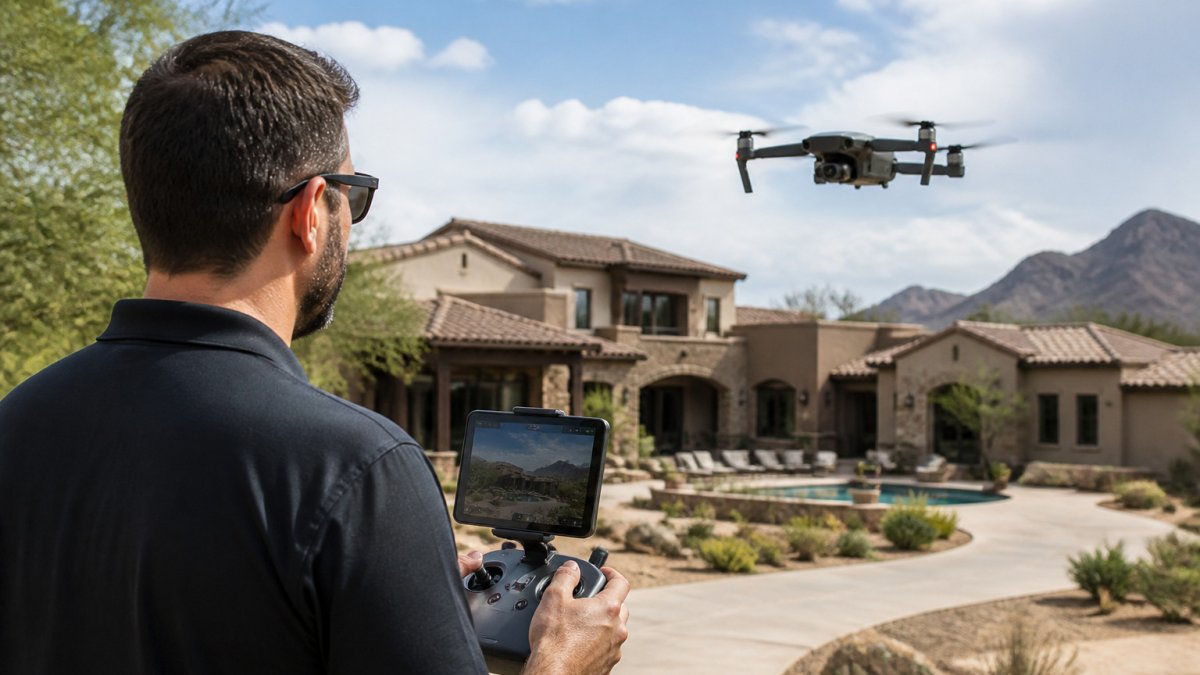
Hiring a licensed drone pilot in Phoenix protects your listing, your liability, and your buyers' trust. Commercial drone work is regulated, and the rules apply to every flight that feeds a property listing.
Drone flying looks simple from the ground. Behind each clean aerial shot, though, the pilot manages airspace, weather, people, and property boundaries at once. According to the FAA's guidance on becoming a certificated remote pilot, commercial operators must hold a valid remote pilot certificate.
Here is what a licensed pilot brings to your project:
- A certificate that proves the pilot passed FAA testing
- Knowledge of where drones may and may not fly
Choosing well takes a few checks. The seven below will help you vet any drone photographer before you sign a contract.
Verify the FAA Part 107 Drone Pilot Certificate
The Part 107 process includes a knowledge test. Our current legal requirements for real estate drone flights explain what the rules cover for listing work. Pilots must pass the test before they can fly for pay. The FAA's Part 107 knowledge test requirements set the rules for who qualifies and how the test works.
How to Check a Certificate Number
- Ask the pilot for their full name and certificate number
- Look up the certificate in the FAA's airmen inquiry database
- Confirm the name matches the pilot who will fly your property
Never accept a photo of a card alone. Verify the record directly.
What Part 107 Lets a Pilot Do and What It Does Not
Some work needs extra approval. Flights near airports or over people may require waivers or special authorization. Ask the pilot how they handle those cases.
Confirm Airspace Authorization for Phoenix Flights
- Identify the airspace class at the property. The pilot pulls up the location on an FAA airspace map and confirms whether the site sits in Class B, C, D, or E controlled airspace, or in Class G uncontrolled airspace. Much of central Phoenix and the surrounding suburbs fall under Class B or Class D shelves tied to Sky Harbor and nearby towered airports.
- Check for a LAANC grid. The FAA's Low Altitude Authorization and Notification Capability (LAANC) system provides near-real-time authorization in many controlled airspace areas up to a published altitude ceiling. The pilot checks whether the property is inside a LAANC-enabled grid and what maximum altitude is automatically approved there.
- Submit the authorization request. For LAANC-enabled locations, the pilot files through an FAA-approved service provider and receives an approval or denial, usually within minutes. For locations outside LAANC coverage or above the grid ceiling, the pilot must file a manual authorization request through the FAA's DroneZone system, which can take days to weeks.
- Check temporary flight restrictions. The pilot reviews the FAA's TFR list for the shoot date. Stadium events, wildfire operations, VIP movement, and security events can close airspace with little notice. A TFR over a Cardinals game or a presidential visit can ground a flight that was otherwise approved.
- Confirm and document approval before takeoff. The pilot keeps a copy of the authorization and the TFR check, and confirms both again on the morning of the flight.
What to Ask About Airspace
A pilot who answers these specifically, with the property address in hand, is doing the work. A pilot who says "it's usually fine" is not.
Phoenix-Specific Considerations
A few local patterns are worth knowing. Properties near Sky Harbor and the flight paths around it often sit under low LAANC ceilings, which can limit how high the drone may fly and therefore how much of a large lot or roofline can be captured in a single frame. Sites near Scottsdale Airport, Deer Valley Airport, and Mesa Gateway have their own controlled airspace shelves. And because the metro hosts large events year-round, TFR checks are not optional. A pilot who plans around these constraints, rather than discovering them on site, keeps your shoot on schedule.
The article walks through airspace checks before any Phoenix flight, and the key steps and their timing are summarised below.
| Step | What the pilot does | Timing |
|---|---|---|
| Identify airspace class | Check the property on an FAA airspace map | Before the flight |
| Check for a LAANC grid | Confirm the LAANC grid and its altitude ceiling | Before the flight |
| Submit authorization | File via LAANC or manual DroneZone request | Minutes (LAANC) to days or weeks (manual) |
| Check TFRs | Review the FAA TFR list for the shoot date | Before the flight |
| Confirm and document | Keep the authorization and TFR check, reconfirm on the day | Morning of the flight |
Review a Drone Pilot Portfolio Before You Hire
Check for these qualities:
- Sharp, level images with consistent color
- Clean framing that shows the full property and its surroundings
- Work on homes in your price range or style
- Examples of the same property features you want to highlight
Check Insurance, Liability and Contract Terms
Insurance and contract terms are where a cheap drone quote can become an expensive problem. A pilot who carries proper coverage and puts clear terms in writing protects you if a flight goes wrong, a file is lost, or the weather does not cooperate. A pilot who avoids those topics is shifting the risk to you.
What Insurance to Request
- General liability coverage that applies to commercial unmanned aircraft operations, not just a homeowner's or hobby policy.
- Coverage limits appropriate to the property and the work. Higher-value listings and commercial sites warrant higher limits; ask what limit the pilot carries and whether it can be increased for your project.
- Additional insured status. For commercial or high-value projects, ask whether you or your brokerage can be added as an additional insured on the policy for the duration of the shoot.
- Active dates. Check that the policy is current and covers the shoot date, not just the date the COI was issued.
- Hull or equipment coverage is the pilot's concern, not yours, but a pilot with equipment coverage is less likely to cut corners to avoid a crash.
Who Handles Permits and Approvals
The contract should state clearly that the pilot is responsible for all flight-related approvals: FAA airspace authorization, TFR compliance, and any waivers needed for the operation. If the property is on private land, confirm who is responsible for obtaining property-owner permission to fly over and launch from the site. For commercial or public sites, ask whether any local property or facility permissions are needed and who obtains them. Put the answer in the contract so there is no dispute on shoot day.
Contract Terms That Prevent Disputes
- Scope of work. The number of flight hours, the specific deliverables (for example, a set number of edited stills, a video length, or a mapping output), and the property address.
- Deliverables and formats. Resolution, file formats, color space, and whether raw files are included or only edited finals.
- Ownership and licensing. Who owns the copyright in the captured imagery, and what license you receive to use it. Confirm whether the license covers MLS use, print, web, and social media, and whether it is exclusive or non-exclusive.
- Weather and cancellation. What counts as a weather cancellation, how much notice is required, and whether deposits are refunded, credited, or forfeited. Phoenix heat, monsoon storms, and high-wind days are real scheduling risks.
- Reshoots. What triggers a free reshoot (for example, a technical failure or an aircraft issue) versus a paid one (for example, a change in the property or a client request), and how quickly a reshoot will be scheduled.
- Turnaround and revisions. The delivery deadline and the number of revision rounds included.
- Liability and indemnification. Who is responsible for damage or injury during the flight, and whether the pilot indemnifies you for claims arising from the operation.
- Payment terms. Deposit amount, due dates, and accepted payment methods.
Questions to Ask a Drone Photographer Before Booking
Asking the right questions before booking saves time and money. Use this checklist in your first conversation:
-
Do you hold an active FAA Part 107 certificate? What is the number?
-
How do you check airspace for my property?
-
Who will fly the drone, and will you handle the flight yourself?
-
Can I see recent work on homes like mine?
Desert Home Photography can provide a current quote on request.
Booking Your Phoenix Drone Shoot With Desert Home Photography
Desert Home Photography provides real estate and architectural photography, hand-blended imagery, immersive virtual walk-through tours, and FAA-licensed drone photography. For tips on scheduling a professional drone shoot, see our guide before you book.
Call or text us to talk through your property and request a quote.
Frequently Asked Questions
How do I verify that a drone pilot is licensed?
Ask the pilot for their FAA remote pilot certificate number and look it up in the FAA's public airmen registry. A valid commercial operator will have a Part 107 remote pilot certificate that is current and in the pilot's name. Ask to see the physical or digital certificate as well. If a pilot cannot provide a certificate number, or the name does not match the registry, do not hire them for commercial work. Also confirm the drone itself is registered with the FAA if it weighs more than 0.55 pounds.
What does an FAA Part 107 certificate allow a drone pilot to do?
A Part 107 certificate allows a pilot to fly small drones for commercial purposes, including real estate photography, inspections and mapping. Pilots must pass the 60-question knowledge test with a 70% passing grade. The certificate does not authorize flying over people, at night without additional training, or beyond visual line of sight without a waiver. Flights are generally capped at 400 feet above ground level and controlled airspace requires separate authorization through the FAA's LAANC system.
What should I ask a drone photographer before hiring them?
Ask about their FAA certificate number, liability insurance coverage, and how they handle airspace authorization for your address. Request a portfolio of recent work similar to your property type, and ask what file formats, number of edited images and turnaround time you will receive. Confirm who owns the final images and whether you can reuse them for marketing. Get a written quote that lists what is included, and ask how pricing changes with the number of properties or the scope of the shoot.
What insurance should a professional drone pilot carry?
A professional drone pilot should carry commercial general liability insurance that covers property damage and bodily injury arising from drone operations. Ask for a certificate of insurance naming you as an additional insured where appropriate, and confirm the coverage limits and policy dates. Some clients require proof of coverage before a shoot. Coverage requirements vary by project, so review the certificate with your broker or attorney if the property is high value or the shoot involves a sensitive site.