 listicle
7 Ways to Improve Real Estate Listing Engagement
Table of Contents
- 1. Invest in Professional Photography to Maximize Listing Engagement
- 2. How to Get Good Listing Photos Without Professional Help
- 3. Real Estate Listing Description Best Practices That Convert Browsers to Buyers
- 4. Benefits of Virtual Walk-Through Tours for Buyer Engagement
- 5. Use Drone Photography and Video Marketing to Stand Out
- 6. Optimize Your Listing for Search Engines and Mobile Browsers
- 7. Build a Post-Engagement Strategy to Convert Listing Views into Leads
- Conclusion
Last Updated: August 19, 2026
Most buyers form their first impression of a property within seconds of landing on a listing, and that impression is almost entirely visual. At Desert Home Photography, we work with agents and homeowners across the Phoenix Valley who understand that weak listing media costs them time, money, and serious buyers. Seven targeted changes can transform how buyers interact with your listings, from the first photo to the final follow-up.
Quick Reference: 7 Ways to Improve Listing Engagement
| Strategy | Primary Benefit | Difficulty |
|---|---|---|
| Professional photography | First impressions, click-through rate | Low (outsource it) |
| DIY photo improvement | Cost control on lower-value listings | Medium |
| Compelling property descriptions | Converts browsers to inquiries | Medium |
| Virtual walk-through tours | Remote buyer engagement | Low (outsource it) |
| Drone photography and video | Stand out in competitive markets | Low (outsource it) |
| SEO and mobile optimization | Organic listing visibility | Medium-High |
| Post-engagement conversion strategy | Turns views into leads | High |
1. Invest in Professional Photography to Maximize Listing Engagement
Professional photography is the single highest-use investment you can make in a real estate listing. According to National Association of Realtors research on home buyer behavior, the overwhelming majority of home buyers begin their search online, which means your photos are doing the selling before any agent ever picks up the phone. Listings with professional imagery consistently attract more clicks, generate more showings, and spend fewer days on market.
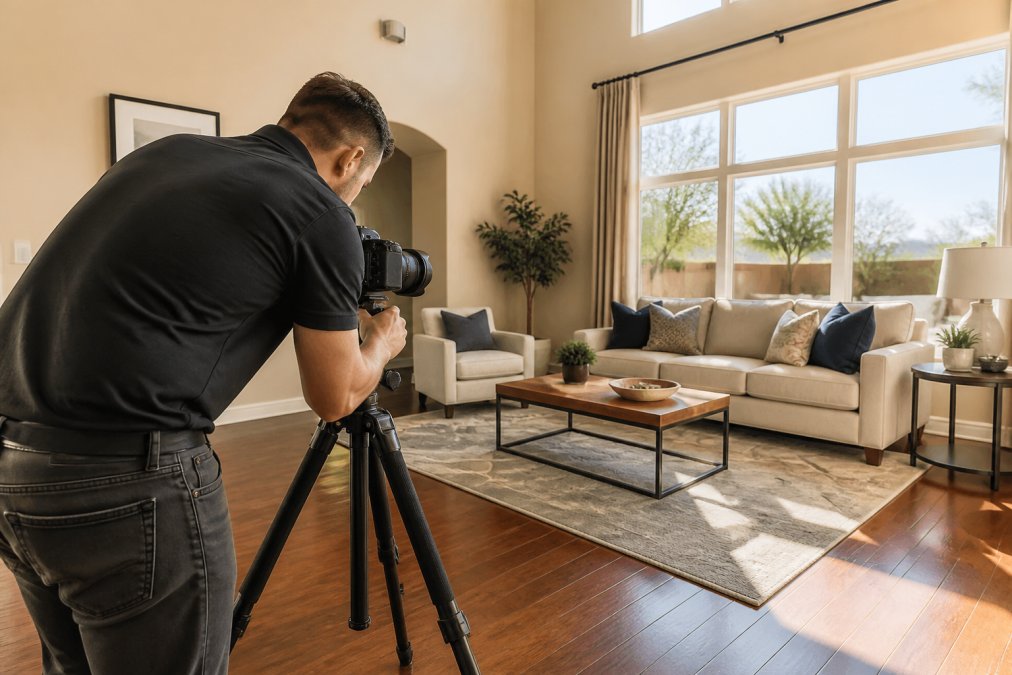
The difference isn't just equipment, it's light, composition, and post-processing. A professional photographer understands how to position shots so rooms read as open and inviting. That knowledge translates directly to buyer engagement: more time spent on listings, more saves, more inquiries.
How Hand-Blended Editing Solves Interior Lighting Problems
Interior lighting is one of the most common problems in real estate photography. The challenge is dynamic range: bright windows versus dimmer interiors. Standard cameras expose for one or the other, leaving blown-out windows or dark, muddy rooms.
Hand-blended editing solves this by combining multiple exposures of the same shot. The photographer captures the room at several exposure levels, then a skilled editor blends them manually. The result shows accurate wall colors, visible window views, and balanced light in a single natural-looking frame. This is the technique Desert Home Photography uses on every shoot to handle Arizona's intense contrast between bright exteriors and shaded interiors.
2. How to Get Good Listing Photos Without Professional Help
Getting good listing photos without a professional is possible but requires discipline. This approach makes sense for lower-priced properties, rentals, or tight budgets. For anything above median market value, the calculus shifts quickly.
Start with these fundamentals:
- Use a wide-angle lens. A 16mm-24mm range (full-frame equivalent) makes rooms read larger. Most smartphone cameras have a wide mode.
- Shoot in landscape orientation. Vertical photos look awkward on listing platforms.
- Stage before you shoot. Remove personal items, clear countertops, add fresh towels, and make every bed.
- Shoot from corner to corner. Position yourself in one corner and shoot diagonally toward the opposite corner to capture maximum depth.
- Bracket your exposures. Take three shots at different brightness levels, then blend using free tools like Lightroom Mobile or Snapseed.
- Shoot during golden hour. Soft morning or late-afternoon light is more forgiving than harsh midday sun.
When DIY Photos Are Costing You More Than You Save
DIY photos on a $600,000 listing are a false economy. If poor imagery causes even one fewer showing per week, the opportunity cost dwarfs photography fees. A useful rule of thumb: if the commission on the sale is more than ten times the cost of professional photography, hire a pro. For most Phoenix Valley listings, that threshold is crossed quickly.
3. Real Estate Listing Description Best Practices That Convert Browsers to Buyers
A listing description is a conversion tool, not a data sheet. Most agents treat it like a bullet list of specs that any buyer could find in MLS fields, wasting the most valuable text real estate you have.
Real estate listing description best practices start with leading on lifestyle, not logistics:
- Open with a scene: "Wake up to mountain views from the primary suite" outperforms "4BR/3BA, 2,400 sq ft."
- Use neighborhood highlights buyers can't find in data: proximity to specific parks, schools, or lifestyle amenities.
- Incorporate address-based keywords naturally for search engine visibility.
- Write for emotion first, then logic. Buyers make emotional decisions and justify them logically.
- Keep paragraphs short. Three sentences max per paragraph.
- End with a clear call to action: "Schedule your private showing today."
Well-written descriptions increase dwell time on your listing page, signaling relevance to search algorithms. The Zillow Consumer Housing Trends Report consistently finds that buyers spend more time on listings with detailed, narrative-style descriptions.
4. Benefits of Virtual Walk-Through Tours for Buyer Engagement
Virtual walk-through tours give remote buyers the ability to experience a property's layout, flow, and scale in ways photos cannot replicate.

The practical benefits for listing engagement are direct:
- Longer time on listing. Buyers exploring a virtual tour spend significantly more time on a listing page than those viewing photos alone.
- Pre-qualified showings. Buyers who request an in-person showing after completing a virtual tour are far more serious than cold inquiries.
- Out-of-state buyer reach. For relocation buyers, a significant segment of the Phoenix market, virtual tours can replace the first in-person visit entirely.
- Competitive differentiation. Listings with immersive virtual tours stand out on platforms like Zillow and Realtor.com.
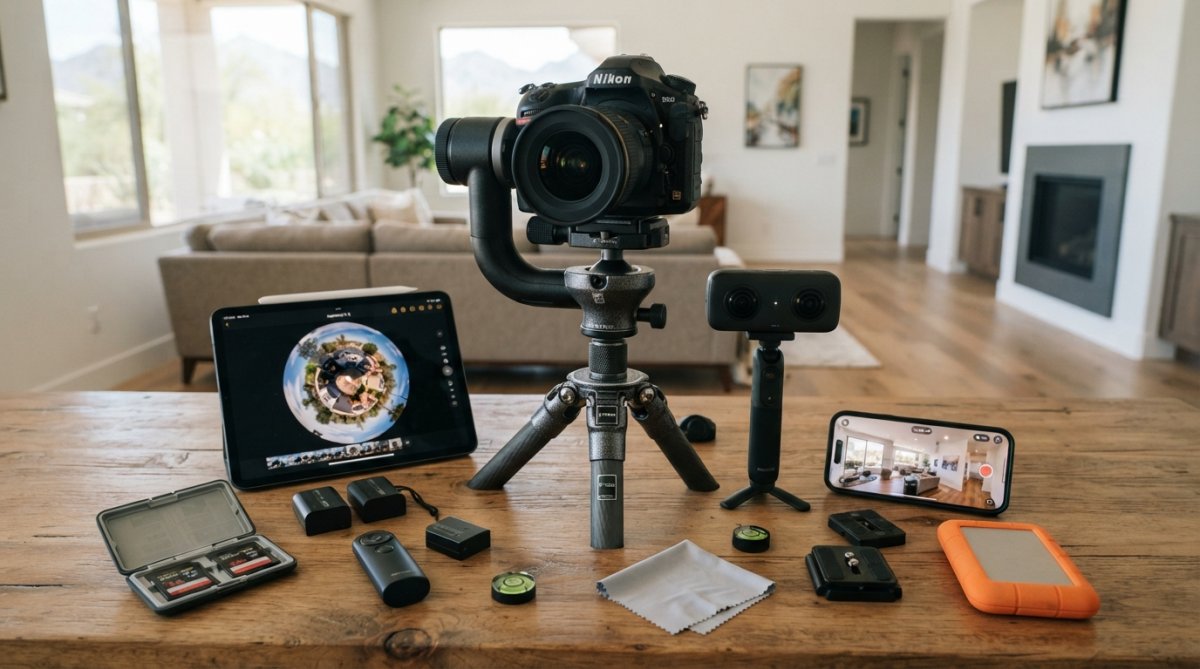
Desert Home Photography offers immersive virtual walk-through tours as part of its media package, integrating directly with major listing platforms.
5. Use Drone Photography and Video Marketing to Stand Out
Aerial perspective changes everything for the right property. Drone photography and video marketing are now a competitive necessity for any listing where lot size, location, or neighborhood context is part of the value proposition.
What drone media communicates that ground-level photography cannot:
- Lot size and boundaries. An aerial shot makes a half-acre lot feel like what it is.
- Proximity to amenities. A drone video panning from the backyard toward a golf course, mountain preserve, or downtown corridor tells a location story instantly.
- Neighborhood character. Mature tree canopy, cul-de-sac positioning, and distance from traffic are all visible from the air.
- Exterior architecture. Rooflines, pool configurations, and outdoor living spaces read far better from above.
FAA regulations govern commercial drone operations. As noted in FAA Part 107 Remote Pilot Certification requirements, commercial drone operators must hold a Part 107 Remote Pilot Certificate. Desert Home Photography's drone operators are FAA-licensed, protecting agents from compliance risk.
Video marketing extends drone content reach significantly. A well-edited property video combining aerial footage with interior clips performs well on social media and generates visibility beyond the MLS.
6. Optimize Your Listing for Search Engines and Mobile Browsers
Search engine optimization for real estate listings is underused by most agents. Listing visibility on Google depends on relevant keywords, quality content, page structure, and mobile performance.
For individual listings, the fundamentals include:
- Address-based keywords in the page title, meta description, and first paragraph
- Neighborhood name and local landmarks woven naturally into the property description
- Alt text on all listing photos describing the room and property type
- Schema markup for real estate listings, which helps Google surface structured data in search results
According to Google's Search Central documentation on structured data, implementing RealEstateListing schema helps search engines understand and display property data accurately.
Mobile-First Listing Optimization Tactics
Mobile-first listing optimization is not optional. The majority of property searches now happen on mobile devices, and a listing that loads slowly or displays poorly on a phone loses buyers before they see a single photo.
Specific mobile-first tactics:
- Compress listing images. Target under 200KB per image using tools like TinyPNG or Squoosh.
- Use responsive listing templates. Confirm your listing platform renders correctly on iOS and Android.
- Prioritize above-the-fold content. The hero image and key specs should load first.
- Test your listing on a real device. Open your live listing on a phone and scroll through it as a buyer would.
- Optimize video for mobile autoplay. Short property preview clips (15-30 seconds) that autoplay silently generate significantly higher engagement.
Click-through rate from search results improves when listings load fast and display cleanly on mobile.
7. Build a Post-Engagement Strategy to Convert Listing Views into Leads
Most listing engagement strategies stop at the view. A buyer who spends three minutes on your listing, saves it, and leaves without contacting you is a warm lead that's gone without a post-engagement strategy.
Post-engagement conversion strategies work by capturing intent signals and following up systematically:
- Retargeting ads. Buyers who visit your listing page can be retargeted on social media with follow-up ads featuring the same property or similar listings.
- Lead capture on listing pages. A simple form offering "Get notified of price changes" or "Request a private showing" converts passive browsers into contactable leads.
- Email marketing sequences. Buyers who opt in can be enrolled in automated campaigns that surface new photos, open house dates, and price adjustments.
- Re-engagement for saved listings. A personal follow-up message referencing the specific property has higher conversion than a generic newsletter.
The goal is to extend the conversation beyond a single visit and keep your listing visible throughout the buyer's decision process.
Using Analytics to Track and Improve Listing Performance
Data-driven listing management is still rare among individual agents, making it a real differentiator. Key metrics to track:
- Click-through rate from search results. Low CTR suggests your hero image or title isn't compelling relative to competing listings.
- Average dwell time. Short dwell time (under 30 seconds) indicates buyers are bouncing, often because photos or description don't match expectations.
- Save-to-inquiry conversion rate. High saves with low inquiries suggests strong interest but a barrier to contact, often an unclear call to action or missing virtual tour.
- Source attribution. Understanding whether buyers find your listing via Zillow, Google organic search, social media, or direct links informs where to invest marketing budget.
Review these metrics weekly during active listings. When dwell time drops or saves plateau without converting, the fix is usually a media update, new hero image, updated description, or virtual tour addition. As documented in National Association of Realtors' 2025 Profile of Home Buyers and Sellers, the most successful listings evolve based on buyer response data rather than staying static.
Improving listing engagement is a system, not a single tactic. Agents who consistently outperform combine great media with smart distribution, conversion-focused copy, and a follow-up process that captures buyers who don't inquire on the first visit. Desert Home Photography helps agents and homeowners execute the media side of that system: professional photography with hand-blended editing, FAA-licensed drone work, and immersive virtual walk-through tours that give every listing a competitive edge. Call or text us to get started and put your next listing in front of more serious buyers.
Frequently Asked Questions
How does high-quality photography impact listing engagement?
Listings with professional photos attract significantly more clicks and views than those with smartphone snapshots. Buyers form their first impression within seconds of seeing a listing image, so sharp, well-lit photos directly affect click-through rate and dwell time. Professional photographers use specialized equipment and editing techniques, including hand-blended imaging, to accurately represent a home's natural light and space, making buyers more likely to schedule a showing.
What role do virtual tours play in increasing property interest?
Virtual walk-through tours let buyers explore a home at their own pace, from any device, before committing to an in-person visit. This filters out less-motivated prospects and attracts serious buyers who are already familiar with the layout. For out-of-state buyers or luxury listings, immersive tours are especially effective at building confidence and shortening the decision timeline, which directly improves conversion rate and reduces days on market.
How can I make my real estate listing stand out from the competition?
The combination of professional photography, a compelling property description, and immersive media like drone footage or virtual tours sets a listing apart. Beyond visuals, optimizing your listing title and description with address-based keywords improves online visibility. A strong call to action and a fast response strategy for incoming leads also matter. Listings that cover all three areas, great media, strong copy, and quick follow-up, consistently outperform those that rely on just one.
What is the rule of 7 in real estate marketing?
The rule of 7 is a marketing principle suggesting a prospect needs to encounter your message at least seven times before taking action. For real estate listings, this means relying on a single platform is rarely enough. Distributing your listing across multiple channels, including MLS syndication, social media, email campaigns, and targeted ads, increases the number of touchpoints a buyer has with your property, which improves the odds they will engage and eventually convert.
Are there liability concerns with drone photography for real estate listings?
Yes. The FAA requires commercial drone operators to hold a Part 107 Remote Pilot Certificate. Using unlicensed drone footage in a commercial real estate listing exposes the agent and homeowner to potential FAA penalties. Always confirm your photographer holds a valid FAA license before using aerial imagery. Licensed operators follow airspace regulations and carry proper documentation, which protects everyone involved in the transaction.
This article was written using GrandRanker