 listicle
High Quality Real Estate Virtual Tours That Sell Homes
Table of Contents
- Why High Quality Real Estate Virtual Tours Outperform Photos
- Benefits of 3D Virtual Tours for Listings and Agents
- What Sets High Quality Tours Apart: Resolution, Flow, and Features
- Matterport vs Zillow 3D Home: Which Platform Delivers Better Quality?
- Real Estate Photography Pricing: Budgeting for Tour Production
- How to Ensure Your Virtual Tour Captures and Converts Leads
- Conclusion: Investing in Tours That Justify a Higher Asking Price
- Frequently Asked Questions
Last Updated: September 6, 2026
Listing photos have carried real estate marketing for decades, but high quality real estate virtual tours now separate homes that sit on the market from those that move quickly. A static gallery shows a buyer what a room looks like; an immersive tour shows them what it feels like to walk through the property. Desert Home Photography produces virtual walk-through tours for Phoenix Valley listings.
Why High Quality Real Estate Virtual Tours Outperform Photos
Buyers scrolling through listings make snap judgments. A photo tells them a room exists, but a virtual tour answers the questions that actually drive decisions: How does the kitchen flow into the living area? Is the master suite actually spacious or just shot with a wide-angle lens? Where do the bedrooms sit in relation to the backyard?
That contextual understanding is the core advantage of virtual tours over photos. When a buyer can navigate a property at their own pace, they build a mental model of the floor plan before ever stepping on site. This pre-qualification means the buyers who do book showings are genuinely interested.

The format also builds trust. Buyers have been burned by listings that hide flaws behind clever angles. A tour that lets them move room to room signals that the seller has nothing to hide, which is a powerful advantage in a competitive market.
Benefits of 3D Virtual Tours for Listings and Agents
The benefits of 3D virtual tours extend well beyond the buyer experience. For agents, the payoff is efficiency and reach. A property with an interactive tour attracts attention from out-of-state buyers and relocating professionals who cannot attend an in-person showing, expanding your buyer pool without expanding your calendar.
For listings, the gains show up in engagement metrics. Properties with virtual tours tend to receive more views and longer average session times than those with photos alone, because the interactive format keeps buyers exploring.
The competitive edge matters most for luxury listings in Scottsdale and Paradise Valley, where buyers expect a polished digital presentation. A high-end buyer comparing two similar properties will gravitate toward the one they can tour remotely.
What Sets High Quality Tours Apart: Resolution, Flow, and Features
Not all virtual tours deliver the same result. A low-resolution tour with jarring transitions can hurt a listing more than photos alone. High quality tours share three defining characteristics.
Resolution and clarity. The tour must hold up on a large desktop monitor, not just a phone screen. High-definition capture with proper stitching prevents the blurry seams and distorted lines that scream amateur production. Buyers notice when door frames bend or countertops warp.
Natural flow and navigation. The best tours replicate the physical experience of walking through a home. Smooth transitions between rooms, logical directional arrows, and intuitive hotspots keep buyers oriented. Confusing navigation breaks immersion and sends buyers back to the search results.
Useful interactive features. Modern tours layer in floor plans, measurement tools, and immersive audio that guides the viewer. These features turn a passive viewing into an active exploration, which is exactly what keeps buyers engaged long enough to form an emotional connection with the property.
Matterport vs Zillow 3D Home: Which Platform Delivers Better Quality?
Choosing the right capture platform is the first production decision, and it shapes the final quality. Two names dominate the conversation: Matterport and Zillow 3D Home. They serve different purposes, and the right choice depends on your listing goals, your budget, and how much control you want over the post-production process.
Matterport: The Professional Standard
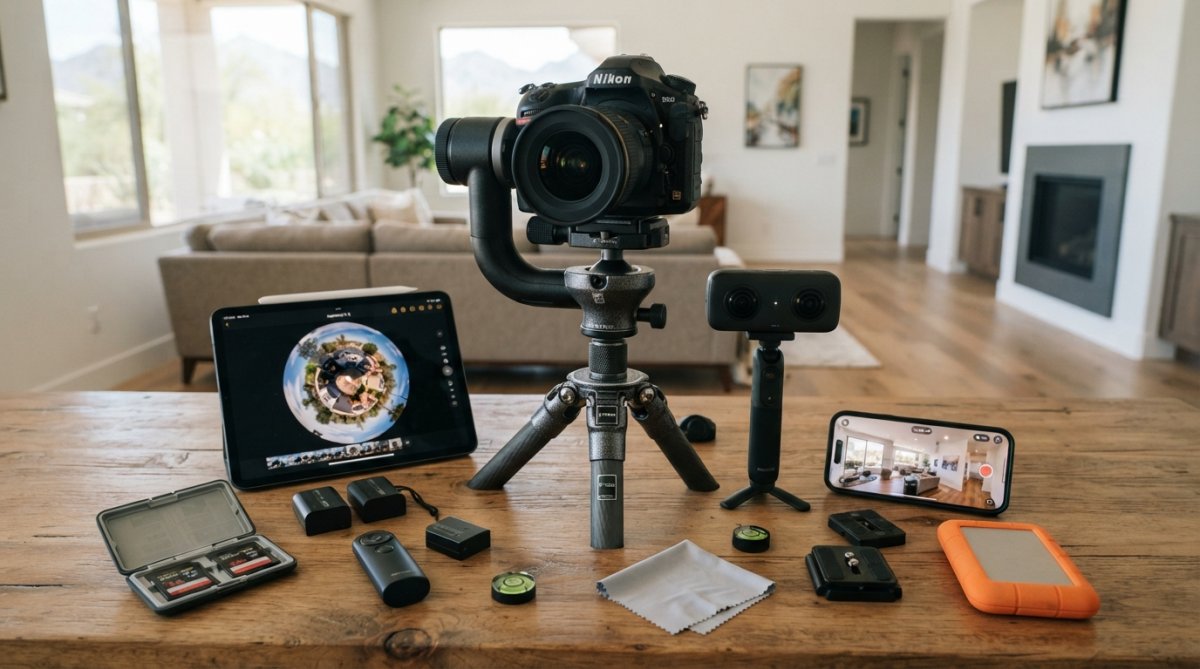
Matterport is the incumbent for a reason. It uses dedicated 3D cameras, most commonly the Matterport Pro2 or Pro3, that capture depth data alongside visual imagery, enabling true-to-scale floor plans, accurate measurement tools, and the "dollhouse" view.
The capture process is methodical. A certified operator moves through each room, stopping every few feet for a full 360-degree sweep. A 2,000-square-foot home typically requires 60 to 90 capture positions and takes 60 to 90 minutes on site (support.matterport.com). The camera stitches those positions into a continuous spatial model, but the real work happens in post-production.
Matterport's processing pipeline is where the quality bar is set. The platform uses AI to align scans, correct exposure differences, and generate the 3D mesh that makes navigation feel seamless. However, that processing is not fully automatic. A skilled editor reviews each tour for stitching errors, adjusts lighting, and verifies the floor plan. This is why Matterport tours from professional photographers consistently look sharper than DIY attempts, the hardware is only half the equation.
There are real trade-offs. The Pro3 camera retails for several thousand dollars, and Matterport charges a per-space processing fee (matterport.com). For an agent shooting one or two listings per month, that cost can be a consideration. For a team handling many listings monthly, the fee may drop with volume pricing.
Matterport also offers a smartphone-based option called Matterport for iPhone, which uses the device's LiDAR scanner to capture spatial data (support.matterport.com). The quality is better than Zillow's offering but still falls short of the Pro3 in low-light performance and scan accuracy. It is a viable middle ground for agents who want Matterport's features without the hardware investment.
Zillow 3D Home: The Free DIY Route
Zillow 3D Home is a smartphone-only solution. You download the app, walk through the property filming each room, and Zillow's software stitches the video into a navigable tour. There is no dedicated hardware, no per-space fee, and no professional operator required.
The quality ceiling, however, is noticeably lower. Zillow's algorithm relies on visual feature tracking rather than depth sensors, so it struggles in low-light interiors and rooms with large blank walls. Spatial accuracy suffers, doorways may appear misaligned. There is also no meaningful post-production workflow; what you capture is what you publish.
There is one significant advantage beyond cost: distribution. A Zillow 3D Home tour is automatically embedded in the listing on Zillow, where most buyers begin their search. Matterport tours can be embedded too, but the process requires a paid integration or workaround.
The Decision Framework
For homes where presentation directly impacts the sale price, luxury listings, architecturally distinctive properties, or homes in competitive markets, Matterport is the clear choice. The measurement tools alone justify the cost; accurate measurements reduce the back-and-forth that delays offers.
For entry-level listings, rentals, or situations where speed matters more than polish, Zillow 3D Home is a reasonable fallback. Just understand the ceiling.
A third option worth noting: some professional photographers now offer tours built on Matterport's technology but delivered through independent hosting platforms. This gives agents the capture quality without locking them into Matterport's ecosystem, and often includes white-label branding.
Real Estate Photography Pricing: Budgeting for Tour Production
Real estate photography pricing varies widely based on square footage, the number of rooms, and the media package selected. A single agent shooting 15 to 20 properties per month needs a pricing model that scales without eating the commission on every sale. The real question most agents skip is not "What does this cost?", it is "What does this tour return on the investment?"
What Drives the Cost
Professional virtual tour pricing varies. Some providers offer entry-level 360-degree tours, while others provide professional 3D spatial tours or premium packages that bundle various media solutions. The price often reflects the operator's time on site, processing fees, and post-production review.
Square footage is the primary cost driver. A 1,500-square-foot condo requires fewer capture positions than a 4,000-square-foot estate. Multi-level properties add time because stairwells and landings are notoriously difficult to stitch cleanly. Significant outdoor space also expands the scope of the shoot.
The ROI Calculation Most Agents Skip
Here is the gap in nearly every pricing guide: the math that connects tour cost to commission. Consider a typical U.S. residential sale. The median home price and standard agent commission vary. The listing agent's share on a home sale can be substantial.
Now apply the industry pattern: listings with professional virtual tours tend to generate more showing requests and shorter days-on-market than comparable listings with photos only. A tour that reduces days-on-market can save the seller in carrying costs.
The more direct ROI is in the agent's own economics. Additional days a listing sits can trigger price reductions. A professional tour can help protect commission.
The Opportunity Cost of DIY
Agents who shoot their own tours save the production fee but pay in time. A Matterport capture takes 60 to 90 minutes on site, plus another 60 to 90 minutes reviewing and correcting the processed tour. For an agent doing 15 listings per month, that is 45 hours, more than a full work week, spent on a task that does not generate leads or close deals.
Professional photographers also bring equipment and expertise that most agents do not own. A $4,000 camera, $2,000 in lighting gear, and software subscriptions represent a significant capital investment. And the learning curve is real: producing a tour that meets the quality bar for luxury listings takes dozens of shoots to master.
A Practical Budgeting Framework
Agents should treat tour production as a marketing investment, not an expense line to minimize. A practical framework is to allocate a portion of the expected commission to listing media. For luxury listings, this allocation can justify a professional tour.
The right question is not "What does this cost?" but "What is the cost of a listing that sits for an extra 30 days?" Carrying costs, price reductions, and the opportunity cost of your time almost always exceed the price of professional media.
Pricing depends on the scope of the shoot, the package selected, and delivery timelines. For a current quote tailored to your listing, contact Desert Home Photography directly.
How to Ensure Your Virtual Tour Captures and Converts Leads
Capturing attention is only half the battle. A tour that generates views but no inquiries is a missed opportunity. Lead capture starts with the tour itself and continues through every touchpoint after.
First, place the tour where buyers will actually find it. The tour should be embedded directly in the listing description and featured prominently on your website. A dedicated landing page with the tour, a photo gallery, and a clear call-to-action converts better than burying the content in a menu.
Second, use the tour data to qualify leads. When a buyer spends several minutes exploring a property and revisits the tour multiple times, that is a high-intent signal. Follow up with those viewers promptly, because their interest is at its peak.
Third, integrate the tour with your CRM. Track which listings generate tour views, how long viewers engage, and which properties produce inquiries. Over time, that data reveals which marketing channels deliver the strongest return.
Conclusion: Investing in Tours That Justify a Higher Asking Price
A high quality real estate virtual tour is not a luxury add-on; it is a pricing tool. When buyers can experience a property remotely and accurately, they arrive at the showing already sold on the layout. That confidence supports a higher asking price and reduces the negotiation use buyers gain from uncertainty.
The challenge is producing tours that meet that standard. Resolution, navigation, and interactive features all matter, and the platform choice shapes the outcome. Desert Home Photography combines immersive virtual walk-through tours with hand-blended imaging and FAA-licensed drone photography to give Phoenix Valley listings a complete, polished presentation. Call or text Desert Home Photography to see how professional virtual tours can elevate your next listing.
Frequently Asked Questions
What is the best virtual tour platform for real estate?
The best platform depends on your goals. Matterport produces high-resolution, dollhouse-style 3D models that work well for luxury listings, while Zillow 3D Home offers a free, simpler option using a smartphone. For professional results that maximize listing engagement, a Matterport tour captured by a trained photographer is the industry standard. A vendor-neutral provider can help you choose the right format for your specific property and budget.
How much does a high quality virtual tour for real estate cost?
Pricing varies based on square footage, the platform used, and whether you bundle the tour with professional photography. Matterport captures typically involve specialized camera and processing. For an exact quote tailored to your property size and needs, request pricing from Desert Home Photography, as costs depend on quantity, dates, and delivery.
How do high quality virtual tours impact listing engagement?
Listings with interactive 3D tours keep buyers on the page longer and reduce time-on-market. High quality tours provide an immersive experience that lets buyers self-qualify before scheduling an open house, which increases conversion rates for showing appointments. They also help out-of-town buyers narrow down choices quickly, making your listing the one they request to see first.
What is the difference between a video walkthrough and a 3D virtual tour?
A video walkthrough is a linear, pre-recorded playback where the viewer has no control over the path. A 3D virtual tour is interactive: viewers click through hotspots, move from room to room at their own pace, and explore the property using user navigation. This self-directed property walkthrough creates stronger engagement because buyers spend more time inspecting details that matter to them.