 how-to
Declutter for a Quick Home Sale: 2026 Guide
Table of Contents
- Why Decluttering Sells a Home Faster
- What Buyers See in the First 90 Seconds
- The Four-Pile Method: Keep, Sell, Donate, Toss
- Room-by-Room Decluttering Strategies
- Your Decluttering Timeline for Home Sale
- How to Prepare Home for Real Estate Photography
- Home Staging Checklist for Sellers
- Decluttering While Living in the House (With Kids and Pets)
- Digital Clutter, Hazardous Waste, and Electronics Recycling
- Frequently Asked Questions
Last Updated: September 18, 2026
Why Decluttering Sells a Home Faster
Learning how to declutter for a quick sale starts with one hard truth: buyers decide in seconds. According to the National Association of Realtors 2025 Profile of Home Buyers and Sellers, most buyers begin their search online, and listing photos shape which homes they tour in person.
What Buyers See in the First 90 Seconds
Buyers form an opinion fast, and that first impression is mostly visual. They scan for light, space, and flow. Clutter breaks all three.
Watch for these instant turnoffs:
- Counters covered with appliances and mail
- Dark, crowded rooms in listing photos
- Personal items that make a home feel like someone else's
- Overflowing closets that signal too little storage
The Four-Pile Method: Keep, Sell, Donate, Toss
The four-pile method assigns every item to one of four categories: keep, sell, donate, or toss. It forces a decision on each object instead of letting it drift back into a drawer. Set up four labeled bins in one room, then work one drawer, shelf, or corner at a time.
- Keep: items you use and will move with you
- Sell: good-condition items worth listing online or through consignment
- Donate: usable items you no longer need
- Toss: broken, worn, or expired items
The Real Obstacle: Emotional Detachment and the Sunk-Cost Trap
Most guides stop at the four bins. Decluttering stalls not from lack of bins but from the sunk-cost fallacy: the pull to keep something because you already paid for it, inherited it, or spent a weekend assembling it. That money is gone either way. Keeping the item only adds the cost of moving, storing, and showing around it.
A few tactics that work in practice:
- Price the move, not the memory. Movers charge by weight and volume, so every box you keep is one you pay to lift, load, and unload.
- Apply the 20/20 rule. If replacing an item costs under about $20 and takes under 20 minutes to buy again, it is not worth the space, a rule of thumb, not a hard formula.
- Photograph and release. For sentimental items with no functional use, take a photo, write one sentence about why it mattered, and let the object go.
- Set a per-item time cap. Give yourself 30 seconds per object in low-stakes rooms. Anything undecided goes into a sealed, dated "maybe" box; if unopened in 30 days, it leaves the house.
- Name the buyer. When you hesitate on furniture or decor, ask whether the next owner would want it. Bold or dated pieces read as clutter in listing photos even in good condition.
When to Sell, Donate, or Just Haul It Away
The four piles are not equal in effort. Selling takes the most time per item and produces the least predictable return. Donating is fast and may support your tax filing with an itemized receipt. Tossing is instant but only works for items no one else can use.
A practical split for most sellers:
- Sell only high-value, easy-to-ship, or easy-to-pick-up items. Furniture, tools, and electronics in working condition qualify. Everything else is not worth the listing time.
- Donate anything usable that would take more than an hour to sell. Local charities, shelters, and thrift stores accept most household goods.
- Toss or recycle anything broken, stained, expired, or unsafe. Check your municipal waste authority for bulky-item pickup rules before you set anything at the curb.
Room-by-Room Decluttering Strategies
Work through your home in a fixed order so nothing gets missed. Start with public rooms, finish with storage areas.
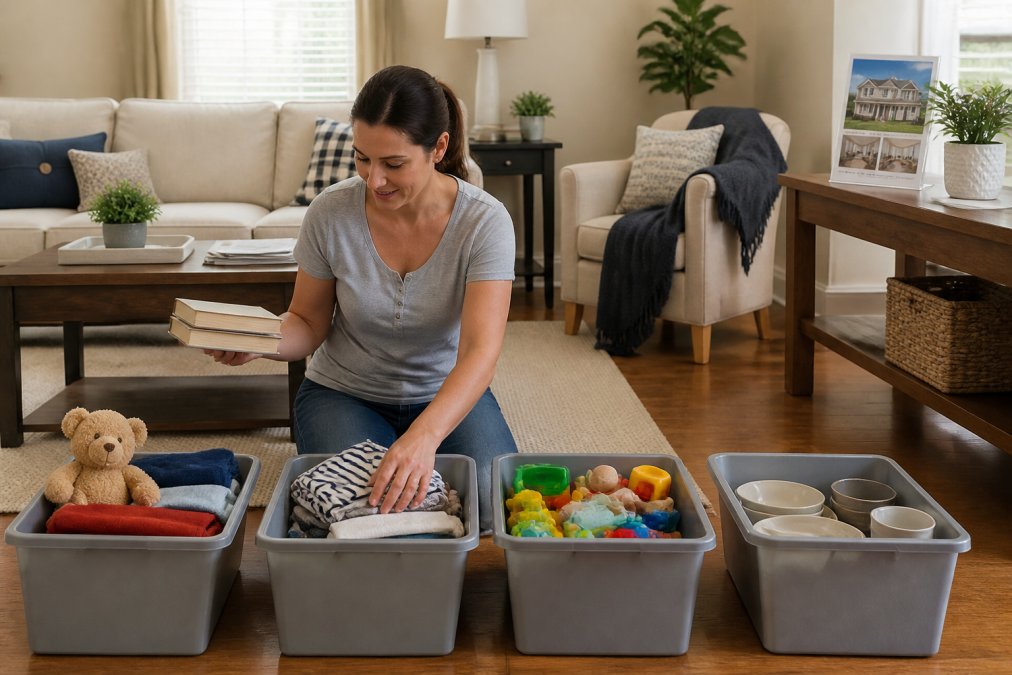
Kitchen and Bathrooms: Countertop Clearance
Countertop clearance is the fastest win in the house. Clear counters make kitchens and baths look bigger and cleaner in photos. Clear everything off, put back only daily-use items, pack the rest, and wipe down every surface.
Bedrooms, Closets, and Cabinet Organization
Closets sell storage, so they need to look roomy. Remove off-season clothes and store them in bins. Leave some empty space on shelves and rods. Buyers open closet doors. An overstuffed closet reads as "not enough room."
Garage, Attic, and Storage Spaces
Garages, attics, and storage spaces are where clutter hides, and buyers check all three. Sweep the garage floor, stack boxes against walls, and consider a storage unit for attic items during your listing period.
Your Decluttering Timeline for Home Sale
A timeline to declutter for a quick sale keeps the work manageable. Start at least four to six weeks before your listing date and work backward.
| Timeframe | Task | Goal |
|---|---|---|
| 6 weeks out | Sort with the four-pile method | Clear 50% of clutter |
| 4 weeks out | Deep clean and depersonalize | Neutral, show-ready rooms |
| 2 weeks out | Touch up paint, fix small repairs | Photo-ready condition |
| 1 week out | Final surface sweep, curb appeal pass | Ready for photography |
| Photo day | Clear counters, open blinds, hide bins | Best possible listing photos |
How to Prepare Home for Real Estate Photography
Knowing how to prepare home for real estate photography is different from everyday tidying. The camera sees things your eye skips. Small flaws become big ones on screen.
Before the shoot:
- Clear all countertops and tables
- Remove trash cans, pet bowls, and cords from view
- Open blinds and turn on every light
- Push chairs in and straighten rugs
- Hide bins, boxes, and cleaning supplies
Home Staging Checklist for Sellers
A home staging checklist for sellers turns decluttering into a finished look. Staging is not decorating. It is arranging each room so buyers see space, light, and possibility.
Use this checklist room by room:
- Remove personal photos, awards, and collections
- Pull furniture away from walls to open traffic flow
- Add one or two neutral accents per room, nothing more
- Match bedding, towels, and curtains to a calm palette
- Fix dim bulbs and replace burnt-out ones
- Clear bathroom counters except one small item
- Set the dining table simply, or leave it bare
- Sweep the porch and add a clean welcome mat
Decluttering While Living in the House (With Kids and Pets)
Living in a staged home with kids and pets is the hardest part. You still need to eat, sleep, and function while the house stays show-ready. The real work is building systems that survive a same-day showing request.
Build a Show-Ready Kit Before You Need It
The biggest time-saver is a pre-packed bin in a closet or your car trunk. When a showing is scheduled, you grab it, sweep the house, and leave. A working kit includes:
- A large lidded tote for loose toys, mail, and pet gear
- A small caddy with glass cleaner, disinfecting wipes, and a microfiber cloth
- A handheld vacuum or cordless stick vacuum
- A clean set of towels for the bathrooms
- A neutral throw blanket to drape over a worn sofa cushion
- A folder with your disclosure documents, in case a buyer's agent asks
A 20-Minute Showing Sweep
Most sellers get one to two hours of notice, sometimes less. A repeatable sweep beats a deep clean:
- Open every blind and turn on every light.
- Clear all counters and tables into the tote.
- Wipe bathroom sinks and put out fresh towels.
- Run the stick vacuum over high-traffic floors.
- Put pet bowls, beds, and litter boxes out of sight.
- Take the tote, the pets, and yourself out the door.
Systems That Keep Kids and Pets From Undoing the Work
Daily habits matter more than weekend deep cleans. A few that hold up:
- One toy basket per child. Everything else lives in a labeled bin in a closet. Rotate the basket weekly so toys stay interesting.
- A pet station by the door. Leash, food scoop, and waste bags live in one caddy that can be lifted into a closet in seconds.
- Feed pets on a washable mat, then put the bowls away. Food and water bowls read as clutter in listing photos.
- Make beds before leaving the house. Every person, every morning. It takes two minutes and changes how the whole room photographs.
- Run a nightly five-minute reset. Everyone picks up their own items before bed. This is the habit that keeps the home from drifting back into clutter between showings.
When to Get the Family Out Entirely
For open houses and photography days, the cleanest move is to leave: load the kids, pets, and show kit into the car for two to three hours. Staying in the home or yard makes buyers uncomfortable and shortens their visit, and rushed buyers do not make offers. If leaving is not possible, confine the family to one room with the door closed; not ideal, but better than a chaotic walkthrough.
Digital Clutter, Hazardous Waste, and Electronics Recycling
Digital clutter matters more than most sellers think. Old smart-home devices, tangled cables, and a cluttered home office desk all show up in photos. Clear the desk, hide cables, and reset any devices you are leaving behind.
Frequently Asked Questions
What should I get rid of before selling my house?
Start with anything that blocks sightlines or makes a room feel smaller: oversized furniture, personal collections, family photos, and countertop clutter. Clear out duplicate kitchen tools, expired pantry items, and worn linens. Then tackle the garage, attic, and storage spaces, since packed storage signals a house without enough room. Items in good condition can go to donation or consignment, and larger loads may need junk removal. The goal is visual space, not empty rooms, so keep a few pieces that show how each room functions.
How long does it take to declutter a house for sale?
Most sellers need two to four weeks of part-time work, though a decluttering timeline for home sale can stretch longer for a house lived in for many years. A practical split: week one for the four-pile method in main living areas, week two for bedrooms and closets, week three for the garage and storage spaces, and week four for final staging and surface clearance. If your listing date is close, hire help or rent a storage unit and move overflow out rather than sorting everything on site.
Does decluttering really help sell a house faster?
It changes how buyers read a home. Open surfaces, clear traffic flow, and organized closets help buyers judge cabinet organization, square footage, and storage instead of your belongings. Decluttering also makes listing photos stronger, and photos drive whether a buyer books a showing at all. Sellers who pair decluttering with professional real estate photography give buyers a clearer view of the home, which supports faster offers and stronger buyer perception during showings and the open house.
How do I declutter when I'm still living in the house?
Work in zones, not whole rooms. Clear one countertop, one closet shelf, or one drawer at a time, then reset it before moving on. Keep a donate box in the garage so items leave the house instead of migrating back. For daily items, use a lidded bin you can tuck into a cabinet before showings. Kids and pets do best with a simple rule: their belongings live in their rooms during the listing period. A storage unit for seasonal and rarely used items takes pressure off the whole process.