 how-to
Drone Imagery for Luxury Real Estate Marketing
Table of Contents
- Why Drone Imagery Matters for Luxury Property Marketing
- Planning Your Drone Photography Shoot for Luxury Homes
- Real Estate Drone Photography Tips for Capturing Premium Properties
- Creating a Drone Photography Shot List for Real Estate
- Real Estate Drone Video: Adding Motion to Your Marketing
- Best Drone Shots for Real Estate Listings
- Managing Privacy, Permissions, and Regulatory Compliance
- Frequently Asked Questions
Last Updated: October 10, 2026
Why Drone Imagery Matters for Luxury Property Marketing
Luxury properties demand premium presentation. Drone imagery luxury real estate is essential to show every angle, feature, and detail that high-end buyers expect before scheduling a showing.
Aerial photography reveals the property's relationship to its surroundings, lot size, landscaping quality, and architectural design from perspectives that create emotional impact. Drone footage transforms listings from static to dynamic, telling a story about location, scale, and prestige.
Listings featuring professional drone imagery receive more inquiries and convert faster. Aerial shots speak directly to luxury buyers evaluating a lifestyle and investment, not just a house.
Drone imagery helps buyers understand property layout and amenities without multiple site visits, reducing showing fatigue and focusing attention on properties matching their criteria.
Planning Your Drone Photography Shoot for Luxury Homes
Success starts before launch. Proper planning ensures you capture priority shots and avoid wasted flight time.
Assessing the Property and Surroundings
Walk the property and identify unique features, sprawling grounds, architectural drama, pools, guest houses, that become shot list priorities.
Note surrounding landscape features (mountains, water, vistas) and obstacles (power lines, structures, trees). Understanding context helps frame the property as premium.
Check sight lines from street and neighboring properties. Showcase privacy and views, both openness and seclusion when relevant.
Checking Weather, Lighting, and Flight Conditions
Golden hour (first hour after sunrise or final two hours before sunset) produces flattering light with long warm shadows and rich colors. Schedule shoots during these windows.
Check forecasts for wind, clouds, and air quality. Avoid wind above 15 mph and overcast conditions. Plan for calm mornings or late afternoons.
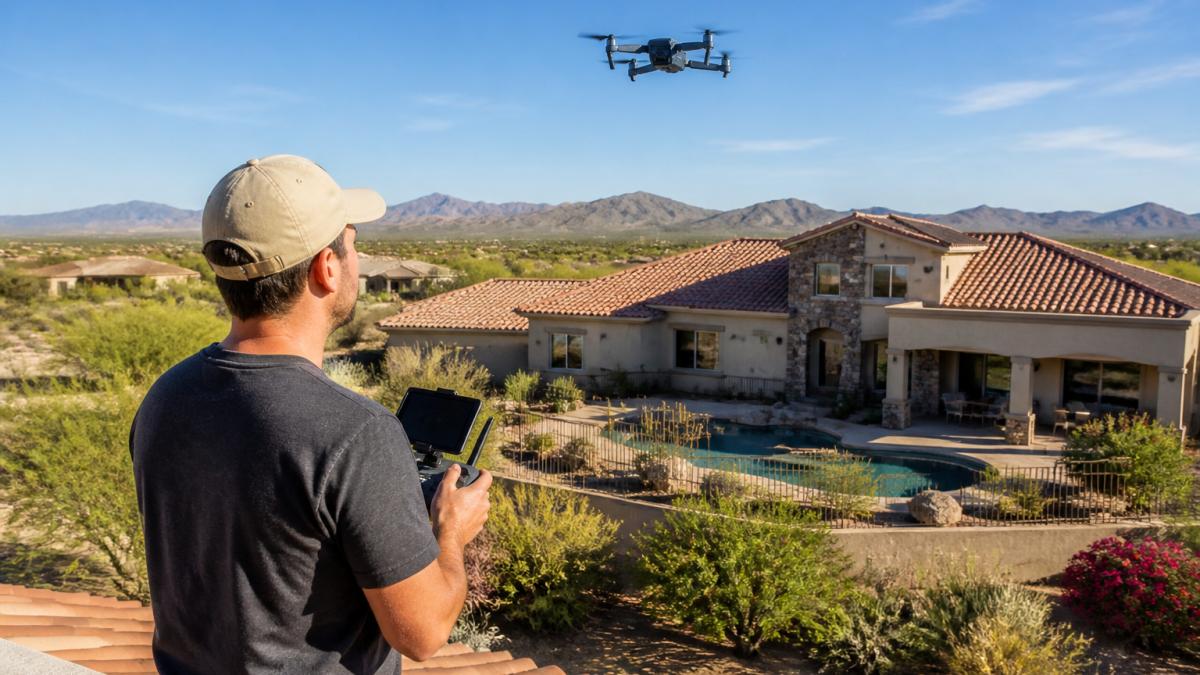
Verify airspace restrictions using FAA airspace maps. Residential areas in populated zones often fall under controlled airspace requiring Part 107 certification. Desert Home Photography operates with FAA-licensed drone operators, ensuring full compliance and liability protection for your listing.
Real Estate Drone Photography Tips for Capturing Premium Properties
Professional drone imagery luxury real estate requires intentional framing that highlights architectural distinction, privacy, scale, amenities, and environmental prestige, what affluent buyers prioritize.
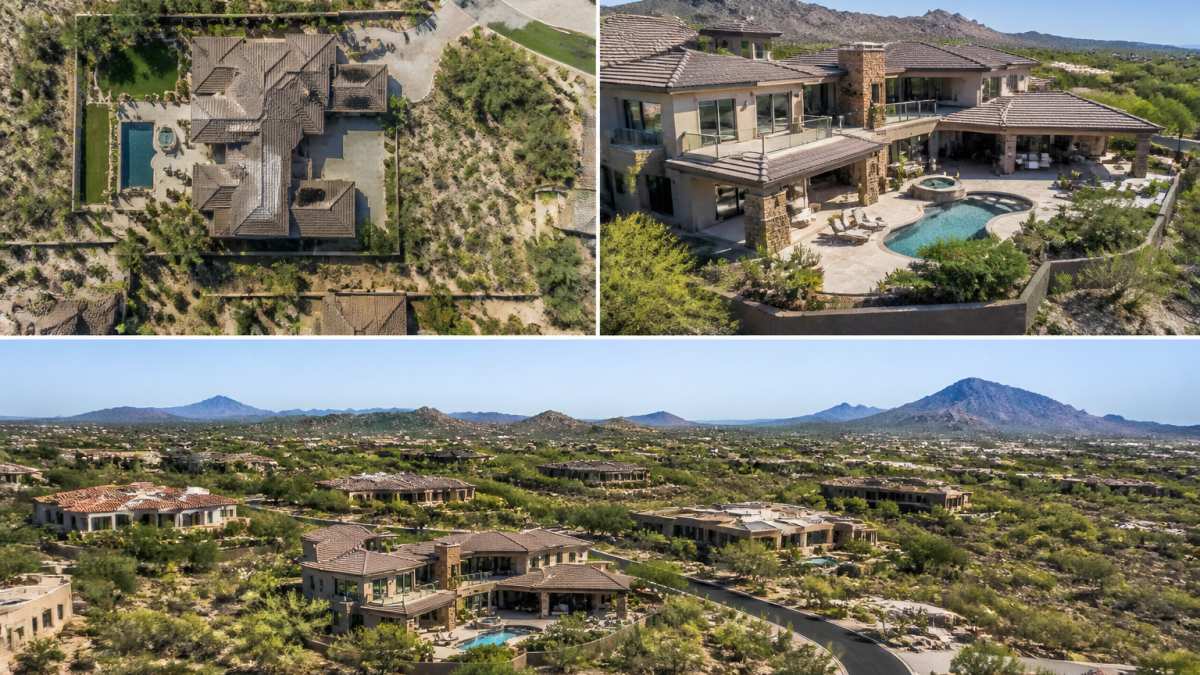
Framing for Luxury Storytelling
Frame the home as the centerpiece of a curated environment, not just a structure:
Architectural prominence: Position the home to emphasize distinctive design elements. Shoot from angles showcasing elevation, rooflines, and façade composition. Use 45-degree approaches for modernist geometry; frontal or three-quarter views for traditional symmetry.
Landscaping as luxury indicator: Frame shots showing the relationship between home and grounds. Include 40-60% landscape context so buyers understand the setting without the home disappearing into scenery.
Privacy and seclusion: Demonstrate how the property achieves privacy through tree coverage, elevation, distance from neighbors, or natural barriers. Frame shots showing property boundaries and buffers from adjacent properties.
Amenities as lifestyle anchors: Dedicate shots to pools, spas, guest houses, and courts, framing them in context of the main home and grounds. These often become hero images in marketing materials.
Views and vistas: Frame shots showcasing mountains, water, or skyline. Position the home in foreground with the view as backdrop, or capture the view from the property's vantage point. Use leading lines to draw the eye toward the vista.
Camera Settings and Image Quality for Luxury Standards
Shoot in RAW format exclusively. RAW preserves maximum tonal range and color information, essential for luxury properties, and provides post-production flexibility for white balance, highlight recovery, and color grading.
Use ISO 100 to 400 to minimize noise. Luxury imagery must be clean and sharp; prioritize low ISO in bright daylight.
Use shutter speed of 1/500th second or faster to eliminate motion blur. Luxury buyers scrutinize sharpness.
Use aperture priority at f/2.8 to f/5.6 to maintain sharp focus across the entire property and landscape. Avoid wider apertures that create shallow focus.
Set white balance to daylight or custom-calibrate to light conditions. Shoot during golden hour when warm light flatters architecture. If shooting midday, expose for highlights and recover shadows in post-production.
Composition Techniques That Elevate Luxury Properties
Apply the rule of thirds: position the home off-center using grid lines. For properties with strong views, position the home in the lower third and the view in the upper two-thirds, or vice versa.
Include context strategically. Frame the property with landscaping, driveway, or terrain, occupying 40-60% of the frame. This demonstrates integration into a premium setting, not isolation.
Vary angles systematically: overhead (lot layout), 45-degree (elevation and detail), distant wide (neighborhood context), close approach (buyer's first impression), and golden hour versions. Each tells a different part of the luxury story.
Creating a Drone Photography Shot List for Real Estate
A shot list connects visual assets to buyer personas, marketing channels, and campaign outcomes. Define what you will shoot, why, for whom, and where each shot will be deployed.
Aligning Shots to Buyer Personas and Campaign Goals
Identify the primary buyer persona, tech executive, retiree, family, and tailor your shot list to their priorities.
Architectural/design-focused: Prioritize distinctive design elements, material quality, and spatial flow. Include architectural details and interior-to-exterior transitions.
Lifestyle/amenity-focused: Prioritize pools, spas, guest houses, and outdoor living. Show scale of grounds and how the property supports entertaining.
Investment/location-focused: Prioritize neighborhood context, proximity to amenities, views, and natural features. Show location prestige and surrounding area character.
Privacy-conscious: Prioritize seclusion, tree coverage, distance from neighbors, and barriers. Show how the property achieves privacy without appearing isolated.
Shot List Organized by Marketing Channel and Deliverable
Organize your shot list by intended use: different channels require different assets.
Listing website hero images (3-5 shots): Full property overview, architectural detail, pool/amenity, neighborhood context, and golden hour shot.
Social media assets (8-12 shots): Vertical, square, and horizontal formats with detail shots, lifestyle shots, and varied angles. Capture enough diversity for 2-3 posts per week.
Video assets (5-8 sequences): 30-second hero video, 60-90 second property tour, 15-20 second amenity highlights, cinematic transitions, and golden hour sequences.
Print and presentation assets (3-5 shots): Large-format hero image, detailed architectural/landscape shots, and lifestyle shots. Ensure technical perfection and composition that works at large sizes.
Email campaign assets (4-6 shots): Thumbnail-friendly shots with clear focal point, horizontal headers, and vertical mobile formats. Composition must be bold at small sizes.
Detailed Shot List for a Typical Luxury Property Shoot
A comprehensive luxury shoot captures 80-150 frames and 5-8 video sequences:
Establishing shots (10-15 frames): Wide overview from street, property overview from 100-150 feet, neighborhood context from 200+ feet, multiple angles for lighting selection, and sunrise/sunset versions.
Architectural and detail shots (15-20 frames): Front, side, and rear elevations; roofline and details; entry; material details; and indoor-outdoor transitions.
Amenity and feature shots (15-25 frames): Pool, spa, patio, guest house, landscaping, water features, driveway, and specialized amenities.
Contextual and lifestyle shots (10-15 frames): Property within neighborhood context, views from the property, proximity to amenities, time-of-day variations, and relationship to surrounding homes.
Video sequences (5-8): 30-second hero, 60-90 second tour, amenity highlight, architectural highlight, cinematic transition, golden hour, and sunrise sequence. A typical shoot requires 2-4 hours and supports 4-8 weeks of marketing content.
Prioritizing Shots Based on Property Strengths
Not every property needs every shot. Prioritize based on what makes this property distinctive:
- Architectural standout: Allocate extra shots to façade, roofline, and design details. Minimize landscape shots unless the landscape is equally distinctive.
- Amenity-rich: Dedicate substantial time to pool, patio, guest house, and outdoor living. Show how amenities integrate with the main home.
- View property: Prioritize shots that showcase the view. Frame the home in foreground with the view as backdrop, or capture the view from the property's vantage point.
- Privacy/seclusion: Emphasize tree coverage, distance from neighbors, and natural barriers. Show how the property achieves exclusivity.
- Neighborhood prestige: Include wider shots showing location context, proximity to amenities, and surrounding area character.
- Large estate: Allocate shots to show scale, overhead views of lot layout, distant shots showing property size relative to surroundings, and multiple angles to convey the property's footprint.
Real Estate Drone Video: Adding Motion to Your Marketing
Video adds dimension that still images cannot match. A 30-60 second clip showing smooth flight around the property creates engagement and holds attention longer than photo carousels.
Cinematic Flight Paths and Video Techniques
Plan smooth, deliberate flight paths. A slow orbit around the property takes 15-20 seconds and creates a cinematic effect showcasing the entire home and landscape.
Use a pull-back move: start close to an architectural feature, then slowly retreat to reveal the full property. This builds drama and context.
Combine vertical and horizontal movement. A slow ascent reveals scale and relationship to environment; a gentle forward glide shows the approach.
Keep video speed consistent at 5-10 mph, slow enough to appreciate details but fast enough to maintain interest.
Editing and Post-Production Workflow
Import clips and trim to strongest segments. Remove jerky movements, wind interference, or poor framing. Select 3-5 best clips.
Color grade for consistency. Adjust white balance, exposure, and saturation to match the property while enhancing appeal. Use warm, inviting tones.
Add subtle background music without lyrics or heavy instrumentation. This creates professional presentation without distraction.
Include text overlays sparingly, address, price, or call-to-action only. Too much text clutters visual impact.
Export video in 4K when possible for larger screen viewing and post-production flexibility.
Best Drone Shots for Real Estate Listings
The property overview shot, a wide angle from 100-150 feet showing the entire home, lot, and immediate surroundings, establishes scale and context. This is your primary listing image.
The approach shot, a perspective from the street or driveway moving toward the home, mimics a buyer's first impression and creates anticipation.
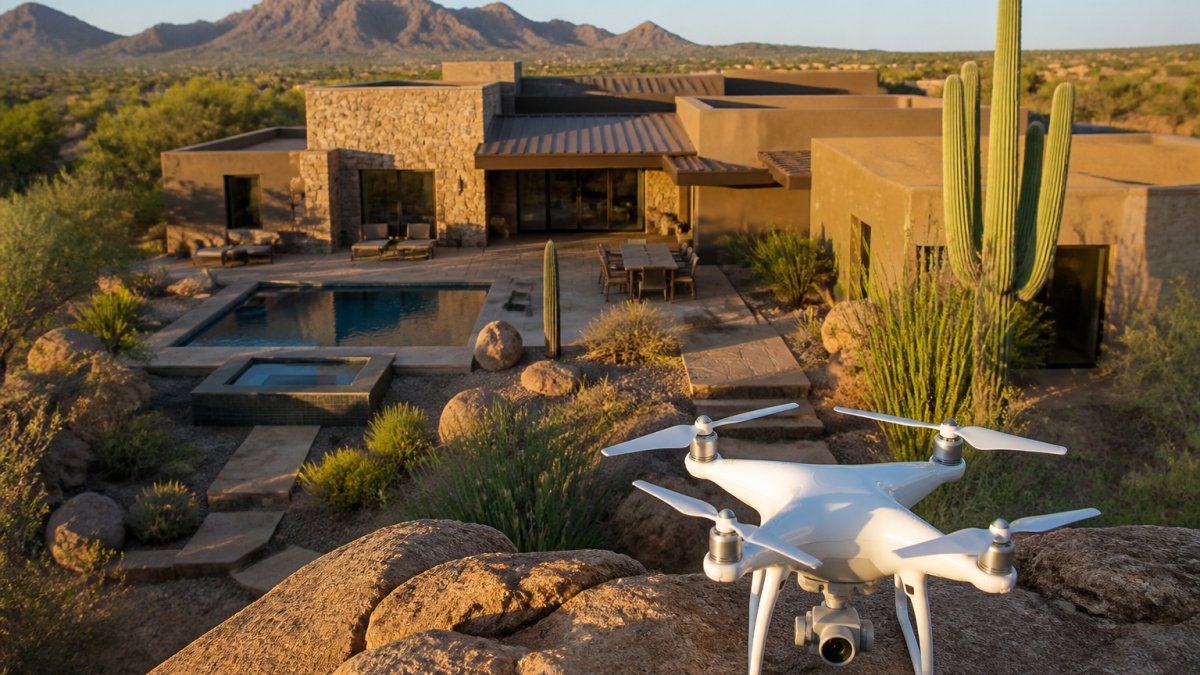
The pool and patio shot, a close-up from 50-75 feet showing outdoor living spaces, landscaping, and architectural details, highlights amenities that drive luxury buyer interest.
The neighborhood context shot, a wider angle showing the property within its surrounding area, nearby homes, and landscape features, demonstrates location value.
The sunset or golden hour shot, any of the above captured during optimal lighting, creates emotional resonance and visual appeal that translates to faster sales.
Managing Privacy, Permissions, and Regulatory Compliance
Drone operations are regulated. Part 107 certification from the FAA is required for commercial real estate photography.
Always obtain written permission from the property owner before flying. Even on private property, you need explicit authorization.
Be mindful of neighboring properties. Avoid flying over adjacent homes or capturing imagery of neighbors' properties without consent.
Check local ordinances. Some municipalities impose additional restrictions on drone operations beyond FAA rules.
Document your compliance. Keep records of Part 107 certification, property owner authorization, and any local permits.
Professional drone imagery for luxury real estate marketing requires planning, technical skill, and attention to detail.
Desert Home Photography brings FAA-licensed expertise to every project, ensuring compliance, safety, and visual excellence.
Ready to showcase your property with professional drone imagery?
Frequently Asked Questions
What makes drone imagery effective for marketing luxury properties?
Drone imagery reveals property size, landscape layout, and architectural features that ground-level photos cannot capture. For luxury homes, aerial shots showcase the entire estate, pool areas, and surrounding neighborhood context, details that appeal to high-end buyers evaluating overall property scale and setting. Drone footage also creates a premium, cinematic presentation that matches buyer expectations for luxury listings.
How should I plan a drone shoot for a luxury property?
Start by visiting the property to identify key features: roofline, pool, grounds, and views. Check weather forecasts for clear skies and plan flight paths that highlight these elements. Scout nearby airspace restrictions using FAA tools, confirm neighbor permissions, and schedule shooting during optimal lighting (early morning or late afternoon). Prepare a shot list covering wide establishing shots, detail angles, and cinematic flight sequences before the shoot.
What are the best drone shots for real estate listings?
Effective drone shots include wide establishing aerials showing the entire property and surroundings, corner-angle shots revealing roofline and architecture, flyover sequences showing property size and layout, and detail shots of pools, patios, or unique landscape features. For luxury properties, include shots that emphasize privacy, views, and the relationship between the home and its setting. Video reveals property dimensions and flow better than stills alone.
Do I need FAA licensing to shoot drone photos for real estate?
Yes. Any commercial drone work, including real estate photography, requires an FAA Part 107 license (Remote Pilot Certificate). This certification confirms the operator understands airspace rules, safety protocols, and operational limits. When hiring a drone operator, verify their Part 107 certification to ensure compliance and protect yourself from liability. Professional operators carry this credential as proof of legitimate, regulated service.