 how-to
How to Organize Closets for Home Showings and Open Houses
Last Updated: October 30, 2026
Quick Summary
To organize closets for home showings, empty each closet completely, sort items into keep, store, and donate piles, then return only about a third of what came out so closets look half full at most. Use matching bins and hangers, sort by category, style, and color, and run a five-minute reset before every showing.
- Empty each closet completely, then return only the keep pile, roughly a third of what came out.
- Measure shelf depth and height before buying bins, and leave at least two inches of clearance above each bin.
- Sort hanging clothes by category, then style, then color, using matching hangers faced the same direction.
- Keep the entry closet to three coats maximum with no shoes on the floor.
- Run the five-minute reset the night before and again the morning of each showing.
Table of Contents
- Why Closets Decide the Sale Before Buyers Open the Door
- Decluttering Closets Before Selling a Home: Start With a Clean Slate
- How to Make a Closet Look Bigger With Storage Bins and Baskets
- Closet Staging Tips for Selling a House: Organize by Category, Style, and Color
- Staging Closets and Storage Areas for an Open House: A Room-by-Room Checklist
- A Realistic Timeline for Closet Prep Before Listing Photos
- Book Your Listing Photography With Closets Camera-Ready
- Frequently Asked Questions
Why Closets Decide the Sale Before Buyers Open the Door
A kitchen can sparkle, but a jammed closet undoes the good impression. Learning how to organize closets for home showings matters more than most sellers expect.
Closet staging is the practice of clearing, sorting, and arranging closet contents so the space looks larger, cleaner, and more useful to buyers during showings and listing photos.
What Buyers Are Really Checking in a Closet
Buyers are not counting your shirts. They are testing whether the home has enough storage for their own life.
- Shelf space: Can shelves hold folded stacks without sagging?
- Hanging space: Is there room for two wardrobes, not one?
- Floor space: Can a laundry basket or suitcase sit out of the way?
A closet that looks packed tells buyers the home lacks storage, even when the square footage is fine. That single impression can make a buyer second-guess an otherwise strong offer.
Decluttering Closets Before Selling a Home: Start With a Clean Slate
Decluttering closets before selling a home works best as a purge, not a tidy-up. Empty each closet completely, then decide what returns.
Follow this order:
- Empty the closet onto a bed or the floor.
- Sort into three piles: keep for showings, store off-site, and donate or toss.
- Wipe down shelves, rods, and the floor.
- Return only the keep pile, roughly a third of what came out.
Most sellers keep far too much. Aim for closets that look half full at most. Buyers read empty space as generous storage, and that perception sells.
What to Do With Everything You Remove
Removed belongings need a home before the first showing, not after. Options that work:
- Rent a storage unit for off-season items and bulky gear.
- Pack labeled boxes into a garage corner or a friend's spare room.
- Donate anything unworn for a year.
A common mistake is stuffing removed items into the garage, where buyers will look next. Move them fully off-site if you can.
How to Make a Closet Look Bigger With Storage Bins and Baskets
How to make a closet look bigger comes down to matching containers, visible empty space, and a system you can reset in minutes before each showing. The same principles apply to the whole home, as covered in how to make your home look bigger in photos. Matching bins and baskets do more for perceived size than any paint color, but only if they are sized and placed with intention.
Choose Containers That Fit the Shelf, Not the Other Way Around
Measure shelf depth and height before you buy anything. A common pattern is shelves that are 12 to 16 inches deep; bins that overhang the edge read as clutter, and bins that barely clear the shelf above make the closet feel packed.
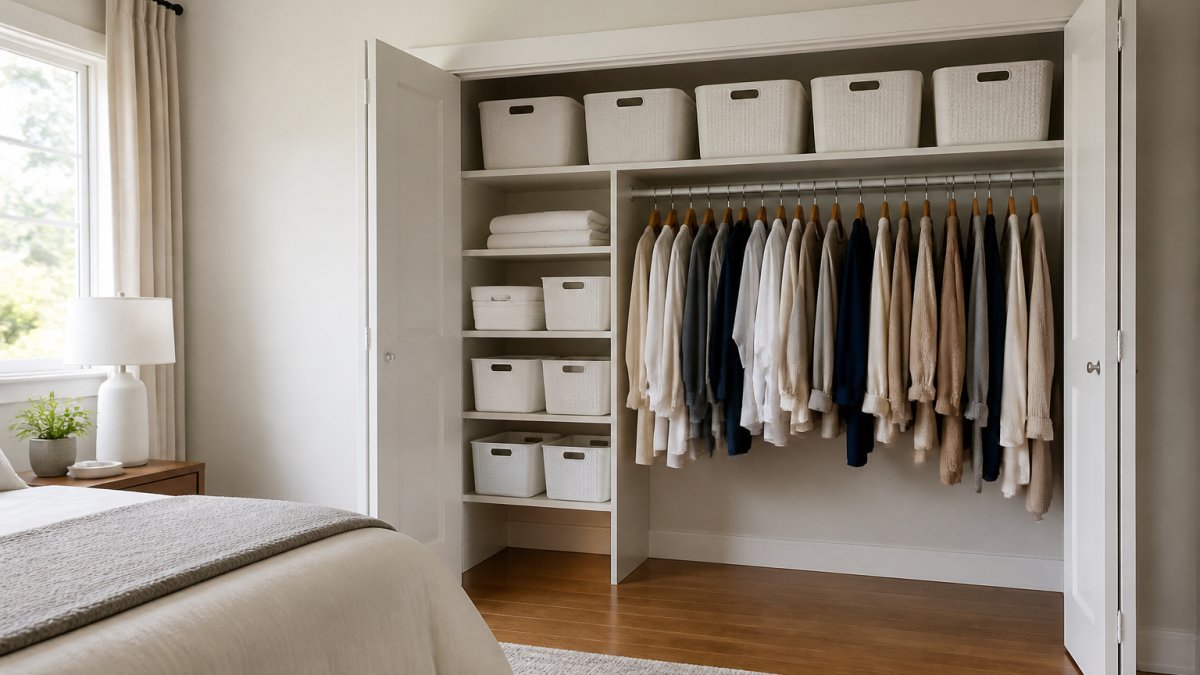
- Use matching bins in one color, ideally white or clear, so the eye reads a single plane instead of a jumble.
- Choose baskets for shelves so loose items disappear, but keep them the same height per shelf.
- Keep boxes uniform in size within a shelf; mixed sizes on one shelf look like overflow.
Watch out: oversized bins that barely fit make a closet look smaller. If a bin is a struggle to pull out, buyers will assume the closet is hard to use.
Where Removed Belongings Actually Go
The containers only work if the items you removed have a home before the first showing. Decide the destination before you start sorting, not after:
- Rent a storage unit for off-season items and bulky gear.
- Pack labeled boxes into a garage corner or a friend's spare room, but only if the garage is also staged. Buyers open garage doors too.
- Donate anything unworn for a year. Schedule a pickup so bags do not sit in the entry closet.
A common mistake is stuffing removed items into the garage, where buyers will look next. Move them fully off-site if you can, and if you cannot, stack boxes against one wall with the labels facing out so the garage still reads as organized.
A Five-Minute Reset Routine for Showing Days
Bins and baskets only sell the closet if they stay arranged. Build a reset routine you can run before every showing:
- Return stray items to their labeled bin.
- Straighten hangers and close gaps.
- Wipe the shelf front edge and the floor.
- Check that doors and drawers open fully.
- Turn on the closet light and replace any burned-out bulb.
Keep a small caddy with a microfiber cloth and spare bulbs in the laundry room so the reset takes one pass, not a scavenger hunt.
Closet Staging Tips for Selling a House: Organize by Category, Style, and Color
Closet staging tips for selling a house start with three organizing passes: category, then style, then color. For broader guidance before professional photos, see our tips for staging homes for professional photography. This sequence is the one most guides skip, and it is what makes a closet look intentional.
- Category: group shirts, pants, dresses, and outerwear separately.
- Style: keep like items together, such as workwear versus casual.
- Color: arrange each group from light to dark.
Use matching hangers throughout. Face hanging clothes the same direction. Leave a finger-width between hangers so fabric is not crushed.
Staging Closets and Storage Areas for an Open House: A Room-by-Room Checklist
Staging closets and storage areas for an open house means treating every storage zone as a selling feature, not a hiding place. Use this checklist room by room, and give each zone a specific target rather than a vague "tidy up."
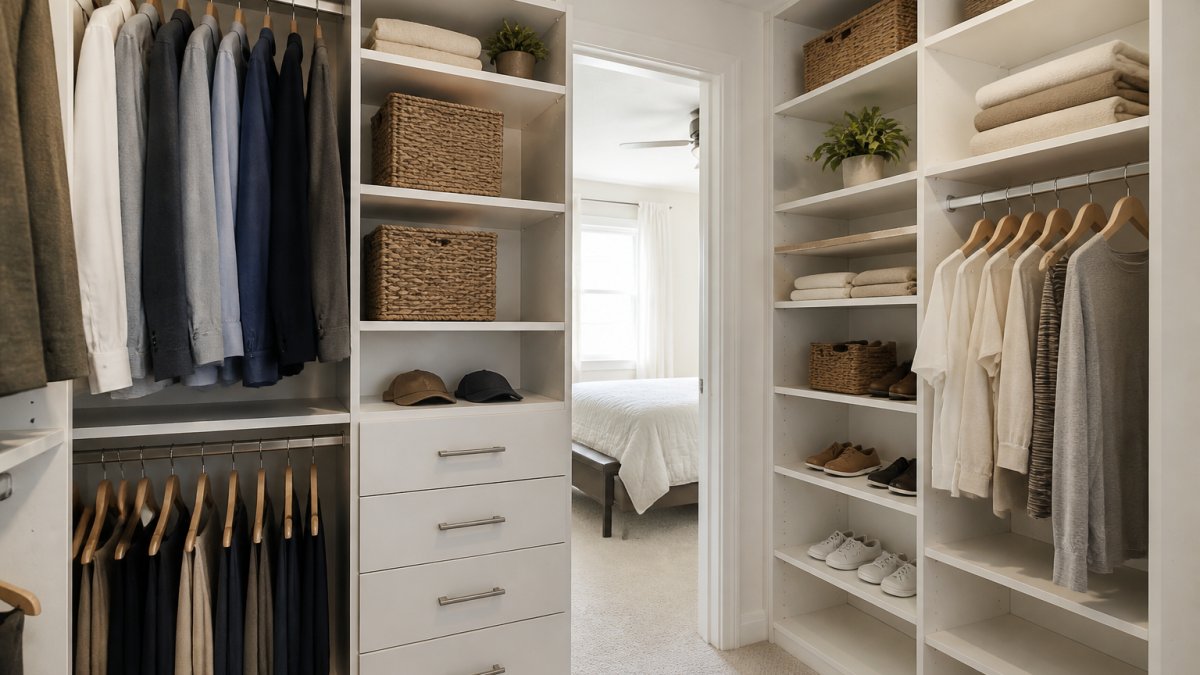
- Primary closet: half full, matching hangers, color-sorted, floor clear
- Guest closet: empty except a few hangers and a folded blanket
- Entry closet: three coats maximum, no shoes on the floor, one umbrella stand
Room-Specific Tactics That Make the Checklist Work
A checklist only helps if each line has a method behind it.
- Primary closet: hang a full outfit at the front as a visual anchor, then leave the next six inches of rod empty. That gap is what buyers read as "room to grow."
- Entry closet: remove the door if it swings into the hallway, and add a battery-powered puck light so the interior is not a dark hole.
- Linen closet: fold sheets into matching rectangles and stack them with the folded edge out. Mismatched stacks read as clutter even when the shelf is clean.
Small, Shared, and Unusually Shaped Closets
Tight or odd closets need different tactics. In small closets, remove the door for showings if it swings into the room, and use a tension rod to add a second hanging level for short items. In shared closets, give each person one side and keep both sides equally sparse; an uneven split reads as one person's overflow. For angled or deep closets, add a light and leave the back shelf empty so depth reads clearly.
Safety and Access Checks Before Every Showing
Safety matters as much as appearance. Buyers open doors quickly, and a falling shelf kills the mood.
- Check that shelves are secured to the wall and rods are anchored into studs, not drywall alone.
- Keep the floor clear so buyers can step in without tripping.
- Avoid unstable stacks; nothing should be balanced on top of a bin.
Showing-Day Maintenance and Household Routines
Closets stay presentable during repeated showings only if the household has a routine. A workable pattern:
- Night before: run the five-minute reset in every closet on the checklist.
- Morning of: do a walk-through with a laundry basket and remove anything that does not belong.
- Before you leave: close closet doors, turn on lights, and take one photo per closet to confirm the reset.
- After each showing: repeat the walk-through before the next appointment.
Keep a printed copy of the checklist inside the primary closet door so family members and your agent can run the reset without asking. For a deeper decluttering plan, use our declutter guide for a quick home sale, and review common mistakes to avoid before real estate photography so nothing gets missed.
A Realistic Timeline for Closet Prep Before Listing Photos
Closet prep runs on a two-week timeline if you start early. Here is the sequence we recommend.
| When | Task | Time Needed |
|---|---|---|
| Two weeks out | Empty and sort every closet | 4-6 hours |
| Ten days out | Move stored items off-site | 2-3 hours |
| One week out | Buy matching bins and hangers | 1 hour plus shopping |
| Three days out | Reorganize by category, style, color | 3-4 hours |
| Day before | Final tidy, wipe surfaces, check lights | 1 hour |
A common mistake is starting the day before the photographer arrives. Closets take longer than kitchens because every item needs a decision.
Book Your Listing Photography With Closets Camera-Ready
Camera-ready closets are half the battle, and the other half is the lens that captures them. Desert Home Photography offers hand-blended imaging, FAA-licensed drone operators, and immersive virtual walk-through tours.
If you want buyers to see the space at its best, get in touch with our team and schedule your shoot.
Frequently Asked Questions
How much should you remove from closets when selling a home?
A common guideline is to clear out roughly a third to half of what's inside each closet. The goal is visible breathing room: space between hangers, a few inches of empty shelf, and open floor space. Pack away off-season items, rarely used items, and anything you haven't worn in a year. Buyers judge storage by how much empty space they can see, so a closet that looks half full reads as generous rather than cramped.
How do you make a small closet look bigger to buyers?
Start by removing the door or leaving it open during showings so buyers can see inside. Use matching slim hangers to reduce bulk, add a light source if the closet is dim, and keep the top shelf mostly empty. Store items in matching bins or baskets so the eye reads one clean line instead of scattered clutter. A mirror on the closet door and a light wall color also help a small closet feel larger.
What is the 3-3-3 rule for decluttering closets?
The 3-3-3 rule is a simple sorting method: work in short bursts of about 30 minutes, sort items into three piles (keep, donate or sell, and toss), and aim to clear three categories of items, such as off-season clothing, shoes, and accessories. It keeps the job from feeling overwhelming and gives you a clear stopping point. Apply it closet by closet so you finish each space before moving to the next.
How do you keep closets tidy between showings?
Build a five-minute reset into your daily routine: rehang anything left out, straighten bins and baskets, and check that floors are clear. Keep a small basket hidden in each closet for quick stashing before a last-minute viewing. When you organize closets for home showings, the goal is a repeatable routine, not a one-time deep clean, so the space stays camera-ready for every open house and virtual tour.
Your closets are staged, sorted, and half empty. Now the photos need to match that effort. Desert Home Photography combines hand-blended editing, FAA-licensed drone coverage, and immersive virtual walk-through tours to make every listing stand out. Get started with Desert Home Photography and give buyers a reason to look twice.